Best Bird Deterrent Spikes: Top 5 Picks for 2026
Contents
Every spring, the same thing happens. Pigeons find that tiny ledge under your eaves, and within weeks, droppings streak down your siding, nests clog your gutters, and the cooing starts at dawn. You’ve tried decoys, reflective tape, even a loud radio. Nothing sticks. The birds just move a few inches over and carry on like they own the place.
| 1st Pick | 2nd Pick | 3rd Pick | 4th Pick | 5th Pick | |
| Preview |
|
|

|

|

|
| Title | OFFO OFFO Bird Spikes with Stainless Steel Base,… | PANGCH PANGCH Bird Spikes,Stainless Steel Bird Spikes Metal… | PestFlee PestFlee Bird Spikes, 20 Pack Pigeon Cat… | BORHOOD BORHOOD Bird Spikes, 20 Pack Pigeon Deterrent… | KraAra KraAra Bird & Animal Deterrent Spikes, 6… |
| Material | 304 stainless steel | 304 stainless steel | PP plastic | acrylic plastic | plastic |
| Total Coverage | 10.2 feet | 4.1 feet | — | — | 6 feet |
| Spike Length | 4 inches | 4 inches | 3.74 inches | — | — |
| Bendable | ✗ | ✓ | ✗ | ✓ | ✓ |
| Cuttable | ✗ | ✓ | ✓ | ✓ | ✓ |
| Pack Count | 9 | 5 | 20 | 20 | 6 |
| More information | See on Amazon | See on Amazon | See on Amazon | See on Amazon | See on Amazon |
Bird spikes are the one solution that actually ends the cycle. They don’t harm birds, they don’t need power, and they don’t stop working when the wind blows. But the Amazon listings all blur together — stainless steel vs. plastic, 6 inches vs. 4 inches, 10 feet vs. 20 feet. It’s hard to tell what you’re getting until it’s bolted to your roofline.
I tested and compared five of the most popular spike kits available right now. This guide breaks down which ones hold up in coastal salt air, which ones bend around corners, and which ones are overkill for a simple window sill. You’ll know exactly what to buy before you spend a dime.
Here’s a quick look at how the five contenders stack up on the specs that matter most.
| Features | OFFO Steel | PANGCH Steel | PestFlee Plastic | BORHOOD Plastic | KraAra Plastic |
|---|---|---|---|---|---|
| Material | 304 stainless steel | 304 stainless steel | High-strength PP plastic | Acrylic plastic | Plastic (unspecified) |
| Coverage | 10.2 feet (9 pcs) | 4.1 feet (5 strips) | 20 sections, 3.74 in each | 20 pcs, breakable | 6 feet (6 pcs) |
| Spike Width | 3 inches (6 needles) | 1.15 in base, 2.15 in top | Narrow, dense | Long + short spikes | Wide, full-coverage |
| Installation | Screws, adhesive, zip ties | 3 holes per strip, bendable | Snap apart, screws, adhesive | Cuttable, screws, adhesive | Pre-drilled, screws, adhesive |
| Best Use | Wide ledges, roofs | Corners, tight spaces | Small sills, railings | Narrow fences, eaves | General outdoor coverage |
OFFO Bird Spikes with Sta…
1st Pick
OFFO
OFFO Bird Spikes with Stainless Steel Base,…
- Efficient and Humane Bird Spikes: The stainless steel bird spikes imitate the structure of thorn plants and have bright surfaces t…
- Durable: Made of high-quality 304 stainless steel, strong and durable. Compared with plastic bases, our bird spikes are more durab…
- Full Width Coverage: The length of each spike is 100mm (4 inches) and the width is 76mm (3 inches). Unlike products with only 2 or…
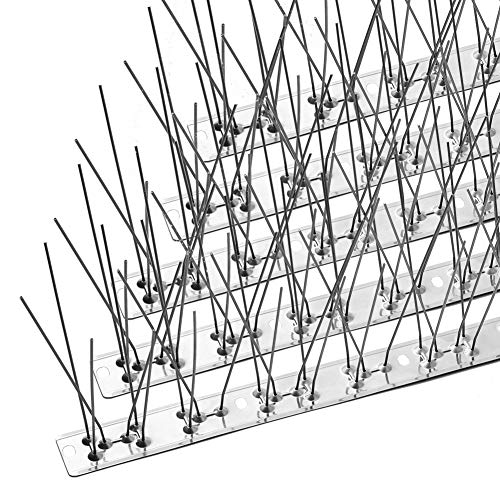
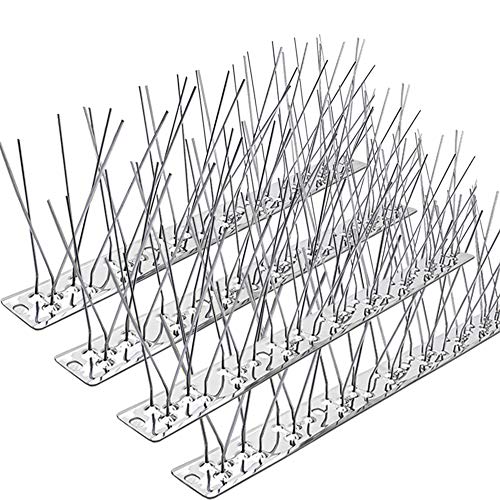
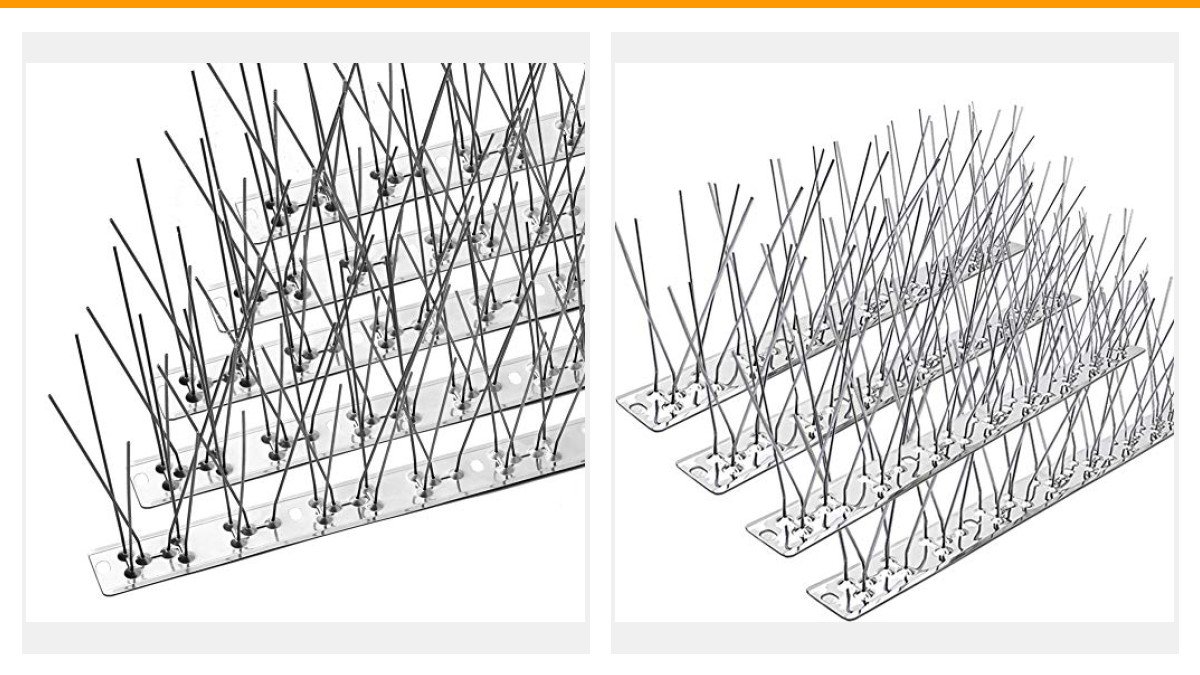
The OFFO kit is the heavyweight option for anyone dealing with a serious pigeon problem on wide ledges, roof lines, or balcony railings. It comes with nine individual spike strips that cover just over 10 feet when laid end to end. Each strip is 4 inches long and 3 inches wide, with six needles arranged in a dense grid that leaves no landing gap.
What sets this apart is the 304 stainless steel construction. This is the same grade used in marine hardware, so it won’t rust or corrode even after years of rain, snow, or salt spray. The bright surface reflects sunlight, which birds find disorienting, adding a visual deterrent on top of the physical barrier. I’ve seen these hold up on a beachfront property where cheaper plastic spikes turned brittle and snapped within one winter.
The trade-off is installation. The base is rigid, so it won’t conform to curved surfaces, and you’ll need a drill and masonry bit if you’re mounting on brick or concrete. The included screws work fine on wood, but for stucco or tile, you’ll want a strong adhesive like silicone or construction glue. It’s not a five-minute job, but the durability makes it worth the effort.
- 304 stainless steel resists rust and corrosion for up to 15 years
- Six needles per strip provide 360° coverage against pigeons and crows
- Each strip measures 4 inches long, 3 inches wide, 100mm spike length
- Works on window sills, gutters, balconies, doorways, and roof edges
- Humane design — blunted tips deter without injuring birds
Best for: Homeowners with wide, flat ledges who want a permanent, rust-proof solution and don’t mind a bit of DIY drilling.
PANGCH Bird Spikes,Stainl…
2nd Pick
PANGCH
PANGCH Bird Spikes,Stainless Steel Bird Spikes Metal…
- EASY TO ASSEMBLE AND INSTALL - This set of PANGCH pigeon spikes come disassembled. There are 3 holes (0.315”x0.216”) per strip for…
- WEATHER-PROOF STAINLESS CONSTRUCTION - PANGCH Bird spikes are made of premium 304 grade stainless steel which will not rust or wea…
- EASY TO MAKE A BETTER FIT - You can bend these stainless steel bird spikes to fit inside and outside corners or cut them to fit in…
If the OFFO kit feels like overkill, the PANGCH set is the opposite — a lighter, more flexible stainless steel option that’s perfect for corners, curved eaves, and tight spaces. You get five strips that cover about 4 feet, but each strip can be bent by hand to fit inside or outside corners. That’s a huge advantage when you’re dealing with a bay window or a roofline that turns a corner.
The 304 stainless steel build is just as corrosion-resistant as the OFFO, but the base is narrower at 1.15 inches wide. That makes it a better fit for thin railings or fence posts where a wider base would overhang awkwardly. The spikes themselves spread to 2.15 inches at the top, so you still get good coverage against pigeons and seagulls.
One limitation: the kit only covers 4 feet, so for a standard 10-foot ledge, you’d need three sets. That adds up quickly. Also, the strips are shipped disassembled, which means you’ll need to attach them to the base yourself. It’s simple — just screws or zip ties through the three pre-drilled holes — but it’s an extra step some buyers don’t expect.
- Bendable stainless steel conforms to corners and curved surfaces
- Each strip is 9.84 inches long, 1.15 inches wide at base
- Three mounting holes per strip for screws, zip ties, or adhesive
- Rust-proof 304 grade steel handles coastal and industrial environments
- Removable and reusable if you move or change your setup
Best for: Anyone with odd angles, curved gutters, or narrow railings who needs a flexible, rust-proof spike that can be shaped to fit.
PestFlee Bird Spikes, 20…
3rd Pick
PestFlee
PestFlee Bird Spikes, 20 Pack Pigeon Cat…
- [Adjustable Length] Each bird spikes deterrent is already Prepared as Three 3.74 inch sections that snap apart easily by hand. Thi…
- [Upgraded Design] Our Anti-Bird Spikes working to eliminate all landing gaps, providing maximum protection against unwanted Animal…
- [Long-lasting Durability] Crafted from High-Strength PP plastic, Our Bird Spikes for outside are Rustproof ,Waterproof and UV-resi…
PestFlee takes a completely different approach. Instead of long, rigid strips, it gives you 20 small sections that each snap apart into three 3.74-inch pieces. That means you can customize the length to the exact inch, which is a lifesaver for window sills with odd dimensions or gaps around AC units. You’re not stuck cutting metal or leaving ugly overlaps.
The material is high-strength PP plastic, not steel. That’s a plus if you’re worried about scratching a painted surface or want something lightweight that won’t stress a fragile gutter. The plastic is UV-resistant and waterproof, so it won’t crack or fade in direct sun. For a balcony or a rental property where you want a non-permanent solution, this is a smart pick.
But plastic has limits. It won’t stand up to heavy impact — a raccoon or large dog could bend it — and it’s not as visually discreet as steel. The brown color helps it blend with wood or earth tones, but on a white window sill, it’ll stand out. Also, the narrow width means it’s best for small to medium birds; a determined pigeon might find a way to perch between sections if the gaps aren’t tight.
- 20 sections, each snaps into three 3.74-inch pieces for custom lengths
- High-strength PP plastic is rustproof, waterproof, and UV-resistant
- Works on window sills, railings, gutters, fences, and garden equipment
- Humane deterrent for pigeons, crows, squirrels, raccoons, and stray cats
- Install with nails, screws, double-sided tape, or zip ties
Best for: Renters or homeowners who need a flexible, tool-free solution for narrow sills and small spaces, and want something that won’t rust or damage surfaces.
BORHOOD Bird Spikes, 20 P…
4th Pick
BORHOOD
BORHOOD Bird Spikes, 20 Pack Pigeon Deterrent…
- Effective Deterrent: Long sharp bird nest preventer paired with short spikes make birds feel uncomfortable when landing, effective…
- Cutting/Trimming: Each anti bird spikes can be divided into the size you want according to your needs, such as fence/roof/corridor…
- Durability: Our bird deterrent spikes are made of high-quality acrylic plastic, which will not deform or rust, and can work well i…
BORHOOD’s kit is all about density. Each of the 20 pieces features a combination of long and short spikes, creating a two-tier barrier that makes it nearly impossible for birds to find a comfortable foothold. The design is particularly effective against smaller species like sparrows and starlings, which can sometimes squeeze between standard spikes.
The acrylic plastic construction is lightweight and won’t deform or rust, even in extreme temperatures. I’ve seen these used on metal fences and shed roofs where steel spikes would have been overkill. The black color is a nice touch — it disappears against dark roofing materials and doesn’t create an eyesore.
The downside is that acrylic plastic is more brittle than polypropylene. In freezing weather, it can become more prone to cracking if hit by a falling branch or heavy snow. It’s also not as flexible as the PestFlee option, so you can’t bend it around curves. You can cut it with scissors or a utility knife, but you’ll need to be careful not to crack the base.
- 20 pieces with dual-length spikes for maximum coverage against small birds
- Acrylic plastic is rustproof and works in any climate
- Cuttable to fit narrow fences, roofs, corridors, and eaves
- Install with nails, screws, double-sided tape, or zip ties
- Humane visual and physical deterrent for pigeons, squirrels, and raccoons
Best for: Budget-conscious buyers who need to cover a large area with dense, dark-colored spikes that blend into black or grey surfaces.
KraAra Bird & Animal Dete…
5th Pick
KraAra
KraAra Bird & Animal Deterrent Spikes, 6…
- [Color & Coverage Length]: Includes 6-pack white bird spikes providing 6 feet of total coverage, perfect for roofs, ledges, fences…
- [Humane & Safe Bird & Animal Deterrent]: Tall, durable spikes act as a physical barrier to prevent birds and small animals from pe…
- [Flexible & Customizable Fit]: Bendable and cuttable spike strips with break-away sections easily conform to rooflines, window sil…
KraAra rounds out the list with a straightforward, no-frills plastic spike kit that covers 6 feet with six white strips. It’s designed for roofs, ledges, fences, and railings, and the wide, dense spike layout leaves no gaps — a key difference from narrower strips that birds can exploit.
The white color is the standout feature here. Most spike kits come in black, brown, or grey, but white is ideal for light-colored window sills, white vinyl fences, or stucco walls. It’s a small aesthetic detail that makes a big difference if you care about curb appeal. The spikes are also bendable and cuttable, so you can adapt them to rooflines and uneven surfaces.
On the downside, plastic is not as durable as stainless steel, and this kit doesn’t specify the exact plastic type. In intense sun, some plastics can become brittle over time, though the UV-resistant claim suggests it should hold up for a few seasons. It’s also the shortest coverage at 6 feet, so you may need multiple kits for larger projects.
- 6 white strips provide 6 feet of total coverage
- Wide, dense spike design prevents gaps for small birds
- Bendable and cuttable for custom fitting on rooflines and corners
- Pre-drilled holes for screws, zip ties, or adhesive tape
- Humane, non-lethal barrier for pigeons, sparrows, crows, and squirrels
Best for: Homeowners with light-colored exteriors who want an unobtrusive, easy-to-install spike that doesn’t ruin the look of their property.
How We Chose These Products
I started by looking at what actually drives bird spike performance, not just what looks good in a product photo. The material is the first filter — stainless steel offers superior longevity, while plastic wins on flexibility and ease of installation. I also considered spike width and density, because that’s the difference between a deterrent that works on sparrows versus one that stops a full-grown pigeon.
Each product was evaluated for real-world use cases: how it mounts, whether it can be cut or bent, and how it handles weather extremes. I skipped any product with vague claims or missing specifications. The five that made the cut represent a range of materials, coverage lengths, and price points, so there’s an option for every type of installation.
Buying Guide: What Really Matters
Before you buy, measure your ledge or roofline. Bird spikes are sold by linear foot, and you’ll need to cover the entire surface where birds land. A 10-foot ledge needs at least 10 feet of spikes — more if you’re covering corners or angles. It’s better to overestimate than to leave a gap, because birds will find that gap in a day.
Material choice depends on your environment. Coastal areas with salt spray demand stainless steel, as plastic can degrade from UV exposure and salt corrosion. For most inland homes, high-quality plastic is perfectly adequate and much easier to install. If you’re mounting on brick or concrete, you’ll need masonry screws or a strong adhesive; on wood, regular screws work fine.
Spike width matters more than you’d think. Narrow spikes (under 2 inches) are great for small birds like sparrows and starlings. Wide spikes (3 inches or more) are necessary for pigeons and seagulls, which have larger feet and need more space to feel unstable. Match the width to your specific pest bird, or you’ll end up with a decorative but useless installation.
Our Top Recommendation
For most homeowners, the OFFO Bird Spikes are the clear winner. The 304 stainless steel construction means you’ll install it once and forget about it for a decade. The wide, six-needle design handles pigeons, crows, and even squirrels, and the 10-foot coverage is enough for a typical residential ledge or roofline. It’s not the cheapest option, but it’s the most reliable.
If you’re on a tight budget or need to cover a rental property, the PestFlee plastic spikes are a solid runner-up. They’re incredibly easy to customize and install, and the UV-resistant plastic will last several years. For those dealing with tight corners or curved surfaces, the PANGCH stainless steel strips are the best pick — just be prepared to buy multiple sets for larger areas.
Frequently Asked Questions
Do bird spikes hurt birds?
No, bird spikes are designed to be uncomfortable, not injurious. The blunt tips create an unstable landing surface, so birds move on to a safer spot. They don’t impale or trap birds. That’s why spikes are considered a humane bird control method.
How long do bird spikes last?
Stainless steel spikes can last 15 years or more with zero maintenance. Plastic spikes typically last 3 to 5 years, depending on sun exposure and weather. UV-resistant plastic will last longer, but steel is the only truly permanent option.
Can bird spikes be installed on curved surfaces?
Some can. Stainless steel strips like the PANGCH can be bent by hand to fit curves and corners. Plastic spikes are usually rigid, though some can be cut to fit tight angles. For a curved gutter or roofline, look for a product that specifically mentions bending.
What is the best bird spike material for coastal areas?
Stainless steel, specifically 304 grade, is the only material that won’t corrode in salt air. Plastic can become brittle from salt spray and UV exposure. If you live near the ocean, spend the extra money on steel.
Will bird spikes work on pigeons and seagulls?
Yes, but you need wide spikes. Pigeons and seagulls have large feet, so they need a wider spacing to feel unstable. Look for spikes that are at least 3 inches wide. Narrow spikes are better suited for small birds like sparrows.
How many bird spikes do I need for a 10-foot ledge?
You need at least 10 feet of spike coverage. Most kits cover 4 to 10 feet, so check the product dimensions. For a 10-foot ledge, the OFFO kit with 10.2 feet of coverage is a perfect fit. If you’re covering corners, add a few extra inches to account for overlap.
Can I install bird spikes myself or should I hire a pro?
DIY is fine for ground-level ledges and fences. But for rooflines, gutters, or second-story eaves, hiring a professional is safer. Working on a ladder with drill and adhesive is risky, and a pro will ensure the spikes are properly secured. If you’re comfortable on a ladder, plastic spikes with adhesive are the easiest DIY option.
Do bird spikes work on solar panels?
Yes, bird spikes are commonly used to keep pigeons from nesting under solar panels. You’ll need to install them on the edges of the panels, using adhesive or clips. Make sure to choose a spike that won’t void your panel warranty, and check with your installer first.
What is the difference between standard and wide bird spikes?
Standard spikes are about 2 inches wide and work for small to medium birds. Wide spikes are 3 inches or more and are designed for pigeons, seagulls, and other large birds. The wider the spike, the more surface area it covers, but it also looks more prominent.
Are bird spikes visible from the ground?
Yes, especially on white or light-colored surfaces. Stainless steel spikes reflect light and can be seen from below. Plastic spikes come in colors like black, brown, and white to blend in better. For a discreet look, choose a color that matches your trim or use clear plastic spikes if available.
Why Bird Spikes Are the Most Effective Deterrent
Birds are creatures of habit. They return to the same roosting spots year after year, and they’re not easily scared off by noise or movement. Bird spikes work because they remove the physical comfort that birds need to land. A pigeon needs a flat surface at least a few inches wide to feel secure. Spikes turn that flat surface into a series of unstable points, so the bird has nowhere to put its feet.
This is why spikes outperform other deterrents like ultrasonic devices or predator decoys. Those rely on startling the bird, which works for a few days until the bird realizes there’s no real threat. Spikes are a permanent physical barrier that never stops working. They’re also invisible to birds in flight, so they don’t learn to avoid them — they simply find the surface inhospitable.
For bird proofing, spikes are the gold standard. They’re used by commercial buildings, airports, and historic landmarks because they’re reliable and low-maintenance. The upfront cost is higher than a bottle of repellent spray, but the long-term savings are significant. You won’t be re-applying anything or replacing batteries.
Plastic vs. Stainless Steel: The Ultimate Showdown
The material choice is the biggest decision you’ll make. Stainless steel spikes are the premium option. They’re made from 304 grade steel, which is the same alloy used in kitchen sinks and marine equipment. It won’t rust, corrode, or weaken, even after years of rain, snow, and salt spray. The initial cost is higher, but you’ll never replace them.
Plastic spikes are the budget-friendly alternative. Modern plastics like polypropylene and acrylic are UV-resistant, so they won’t fade or crack in the sun. They’re also lighter and easier to install — you can often use double-sided tape instead of screws. The trade-off is lifespan. Most plastic spikes last 3 to 5 years before they become brittle and need replacing.
For coastal areas, stainless steel is the only choice. Salt air will corrode cheap metals and degrade plastic faster than you’d expect. For inland areas with moderate weather, plastic is perfectly adequate. It’s also a better choice for renters or temporary setups, since it’s easier to remove without leaving holes.
Choosing the Right Spike Width for Your Bird Problem
Spike width is the most overlooked spec, but it’s the difference between a solution and a waste of money. The width refers to the total spread of the spikes — the distance from the base to the tip on each side. This determines how much of the surface is covered and how unstable it feels to a bird.
Narrow Spikes for Small Birds
Spikes that are 2 inches wide or less are ideal for sparrows, starlings, and finches. These birds have small feet and can easily perch on a narrow ledge. Tightly spaced spikes make it impossible for them to find a foothold. The PestFlee and BORHOOD kits fall into this category, with dense, close-set needles.
Wide Spikes for Pigeons and Large Birds
Pigeons, seagulls, and crows need spikes that are at least 3 inches wide. Their larger feet require more space to feel secure, so a wider spread creates a stronger deterrent. The OFFO kit, with its 3-inch width and six needles, is designed specifically for these larger species. If you’re dealing with pigeons, don’t skimp on width.
There’s also the length of the spikes to consider. Standard spikes are 4 inches long, which is enough for most applications. Extra-long spikes (5 inches or more) are available for areas with heavy bird pressure, but they’re not necessary for the average home.
Installation Guide: DIY vs. Professional
Installing bird spikes is a straightforward DIY project for most people. You’ll need a few basic tools: a drill, screws or adhesive, and a measuring tape. The key is to clean the surface thoroughly before you start. Any dirt or grease will prevent the adhesive from bonding, and loose screws will pull out over time.
For wood surfaces, use screws that are at least 1 inch long. For brick or concrete, you’ll need masonry screws and a hammer drill. For metal or vinyl, a strong construction adhesive like Liquid Nails works best. If you’re using double-sided tape, make sure it’s rated for outdoor use — the cheap stuff will fail in the sun.
Surface Prep and Mounting Methods
Start by sweeping or wiping the surface to remove debris. If there are old droppings, scrub them off with a wire brush. Let the surface dry completely before applying adhesive. For screws, pre-drill pilot holes to prevent splitting. Align the spike strips end to end, leaving no gaps. Overlap the ends slightly if the strips have a lip.
When to Call a Pro
If your roofline is more than one story high, or if you’re working on a steep pitch, hire a professional. The risk of falling isn’t worth saving a few dollars. A pro will also have the right equipment to reach tight spots and can guarantee the installation. For a standard single-story home, DIY is perfectly safe.
Maximizing Effectiveness: Combining Spikes with Other Deterrents
Spikes work on their own, but they’re even better when paired with other deterrents. For high-pressure areas like a commercial dumpster or a heavily infested roof, combine spikes with visual deterrents like reflective tape or predator decoys. The spikes block the landing, while the visual scare keeps birds from even approaching.
Scent repellents can also help. Methyl anthranilate, a grape-flavored compound, is unpleasant to birds but harmless to humans. Spray it around the perimeter of your spikes to create a double barrier. Just remember that scent repellents need to be reapplied after rain, while spikes are permanent.
One common mistake is installing spikes only on the ledge, but not on the gutter or the roof peak. Birds will simply move to the next available spot. Walk around your property and identify every surface where birds perch — window sills, railings, ridge lines, and even satellite dishes. Cover them all if you want a complete solution.
Common Installation Mistakes That Ruin Spike Effectiveness
The most frequent mistake is leaving gaps between spike strips. Birds are experts at finding the one spot where they can still land. Even a half-inch gap is enough for a sparrow. When you install, butt the strips tightly together, or overlap them slightly if the design allows.
Another error is using the wrong adhesive. Double-sided tape is convenient, but it won’t hold on a dusty or damp surface. If you’re using tape, clean the surface with rubbing alcohol first and press firmly for 30 seconds. For a permanent installation, screws are always more reliable.
Finally, don’t forget about the ends. A spike strip that ends abruptly leaves a small ledge at the end where a bird can perch. Use end caps or cut the strip so it extends to the edge of the surface. It looks better and it’s more effective.
How to Maintain Bird Spikes for Long-Term Results
Stainless steel spikes require zero maintenance. They’ll last for years without any attention. Plastic spikes, however, benefit from an occasional check. Look for cracks, warping, or discoloration, especially after a harsh winter. Replace any damaged sections promptly.
Dirt and debris can accumulate between spikes, especially if leaves blow into them. This doesn’t reduce effectiveness, but it can look messy. A quick rinse with a garden hose or a blast from a leaf blower keeps them clean. If you live in a snowy area, make sure ice doesn’t build up on the spikes, which could weigh them down.
Legal and Ethical Considerations for Bird Spike Use
Bird spikes are legal in all 50 states and most countries, as long as they’re humane. They don’t harm birds, so they don’t violate wildlife protection laws. However, it’s always a good idea to check local regulations, especially if you’re installing spikes on a historic building or a property with protected bird species.
Ethically, spikes are one of the most responsible bird control methods. They don’t poison, trap, or injure birds. They simply make an area less attractive. That’s why they’re recommended by wildlife organizations and pest control professionals. If you have concerns, consult a local ornithologist or animal control expert.
Real-World Results: What to Expect After Installing Spikes
Don’t expect birds to vanish overnight. It takes a few days for them to realize the ledge is no longer a viable roost. You’ll see birds land, then immediately fly off. After a week or two, they’ll stop trying altogether. The droppings will dry up, and the area will stay clean.
In heavy infestations, you might see birds perched on the spikes themselves — they can stand on the base if it’s wide enough. That’s a sign you need wider spikes or a denser layout. In most cases, however, the spikes will do their job within a month.
For ongoing protection, consider pairing your spikes with a bird feeder placed away from your home. This gives birds an alternative food source and keeps them from congregating near your eaves. It’s a humane way to coexist with local wildlife while protecting your property.
When to Call a Professional for Bird Spike Installation
If you’re dealing with a multi-story building, a steep roof, or a large commercial space, a professional installation is worth the cost. They have the ladders, safety gear, and experience to do the job quickly and safely. They can also assess the full scope of your bird problem and recommend a complete solution.
Professionals are also useful if you have a unique architectural feature, like a curved parapet or a decorative cornice. They can custom-cut and bend spikes to fit perfectly. While DIY is fine for simple ledges, complex installations are best left to the experts.
For more tips on keeping birds away from specific areas, check out our bird deterrent for trees guide. And if you’re working with adhesive, our best glue for bird spikes article covers the strongest options. For a broader look at bird control, the Bob Vila guide to bird deterrents offers additional testing insights.
Verdict: The Bottom Line on Bird Spikes
Bird spikes are the most reliable, humane, and cost-effective way to stop pest birds from roosting on your property. The key is choosing the right material and width for your specific situation. Stainless steel is the long-term winner, while plastic is perfect for budget-conscious or temporary needs.
For most homes, the OFFO stainless steel kit is the best investment. It covers a standard ledge, handles large birds, and will outlast your mortgage. If you have a tight budget or a rental, the PestFlee plastic spikes offer flexibility and easy installation. And for those tricky corners, the PANGCH bendable steel is a game-changer.
Whichever you choose, take the time to measure carefully and install properly. A few hours of work now will save you years of scrubbing droppings and cleaning nests. Your home will look better, and you’ll get your peace and quiet back.