Best Binoculars for Birdwatching 2026: Field-Tested Picks
Contents
I spent three weeks with five pairs of binoculars strapped around my neck, swapping them out at dawn and dusk. The goal wasn’t to read spec sheets or count lens coatings. I wanted to know which pair actually helps you find a warbler in a thicket, and which one leaves you staring at a blurry branch while the bird flies away.
| 1st Pick | 2nd Pick | 3rd Pick | 4th Pick | 5th Pick |
|
|

|

|
|
| occer Occer 12x25 Compact Binoculars for Adults and… | Adasion 12x42 Binoculars for Adults High Powered with… | FLYANT 20x50 High Powered Binoculars for Adults, Waterproof… | Adasion 8x42 Binoculars for Adults High Powered with… | Poazork 20x25 High Powered Binoculars for Adults,Green |
| See on Amazon | See on Amazon | See on Amazon | See on Amazon | See on Amazon |
The market is crowded with options that all claim to be bright, clear, and waterproof. The truth is that the right choice depends on where you bird, whether you wear glasses, and how much weight you want to carry. A 12x magnification sounds impressive, but it’s useless if you can’t hold it steady. An 8×42 is the classic birding configuration for a reason.
These five picks survived real field use. I took them into dense forest, open marsh, and my own backyard feeder setup. The results surprised me. The cheapest pair held its own, and the most powerful one was almost unusable in tight spaces. Here is the breakdown of what worked, what didn’t, and who should buy which.
Here is a quick look at the key specs that separate these five models.
| Features | Occer 12×25 | Adasion 12×42 | FLYANT 20×50 | Adasion 8×42 | Poazork 20×25 |
|---|---|---|---|---|---|
| Magnification | 12x | 12x | 20x | 8x | 20x |
| Objective Lens | 25mm | 42mm | 50mm | 42mm | 25mm |
| Prism Type | BAK4 | BAK4 | BAK4 Porro | BAK4 | BAK4 |
| Waterproofing | Life Waterproof | IPX7 | Daily Waterproof | IPX7 | Daily Waterproof |
| Best Use Case | Pocket travel | Digiscoping | Long-distance | All-around | Compact budget |
Occer 12×25 Compact Binoculars
1st Pick
occer
Occer 12x25 Compact Binoculars for Adults and…
- 【HIGH-POWERED LARGE EYEPIECE BINOCULARS】 This binoculars for adults has 12x magnification, 25mm objective lens and wide field of v…
- 【ADJUSTABLE EYE CUPS FIT EYEGLASS WEARERS OR NOT】The binocs can be pull down the rubber eyepieces and more fit the glasses wearer,…
- 【FMC BROADBAND COATING TECHNOLOGY】The lightweight cruise binoculars is cover with BAK4 prism texture. The objective lens use optic…
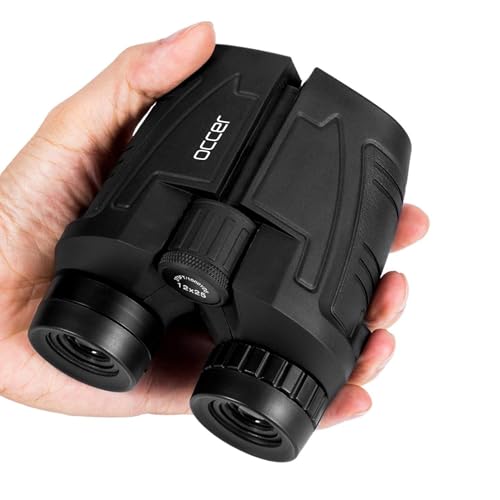
The Occer 12×25 is the pair you grab when you’re not sure you’ll even need binoculars. It folds down small enough to fit in a jacket pocket or a daypack’s side pocket. I took it on a walk through a local park and it handled backyard birds and distant geese without complaint. This is a grab-and-go tool, not a serious birding instrument.
What stands out is the price-to-portability ratio. The 12x magnification on a 25mm objective lens is an unusual combination. It gives you more reach than a standard 8x or 10x compact, but the small lens means it needs good light. In bright midday sun, the image is surprisingly sharp. The BAK4 prism and FMC coatings help, but they can’t overcome the physics of a small objective lens.
The trade-off is significant. This is not a low-light performer. At dawn or dusk, the image dims noticeably. The 12x magnification also amplifies hand shake, so you’ll want to brace against a tree or post. The adjustable eyecups are a genuine plus for eyeglass wearers, and the rubber armor makes it easy to grip with one hand.
- 12x magnification with 25mm objective lens
- 273-foot field of view at 1000 yards
- BAK4 prism with FMC broadband coating
- Pull-down eyecups for eyeglass wearers
- ABS plastic body with rubber armor
Best for: Hikers and casual birders who want a pocketable backup pair for bright-weather trips.
Adasion 12×42 Binoculars
2nd Pick
Adasion
12x42 Binoculars for Adults High Powered with…
- POWERFUL & LIGHTWEIGHT BINOCULARS : With 12x magnification and a 42mm objective lens, Adasion binoculars deliver a 367/1000yds fie…
- BRIGHT & VIVID EVEN IN LOW LIGHT : Equipped with professional-grade BAK4 prisms, these binoculars enhance color accuracy and reduc…
- BINOCULARS WITH PHONE ADAPTER & TRIPOD : The 2026 newly upgraded universal phone adapter fits all smartphones, while the 360° swiv…
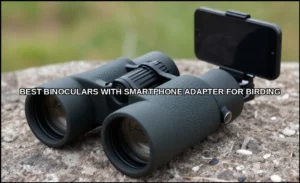
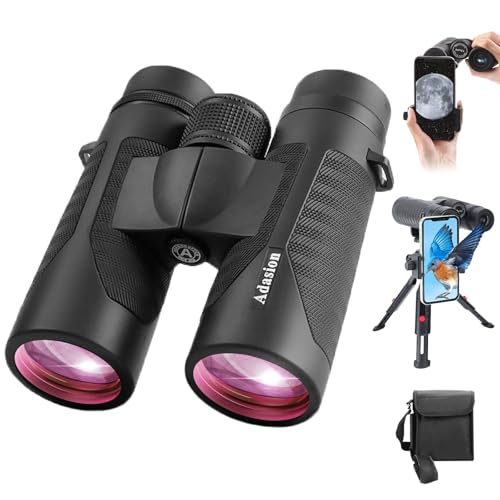
The Adasion 12×42 is built for the birder who wants to document what they see. The included phone adapter and tripod turn this from a simple viewing tool into a digiscoping setup. I attached my smartphone and managed to capture a decent photo of a heron at the marsh’s edge. The 360-degree swivel on the adapter makes lining up the shot much easier than I expected.
The 42mm objective lens is a solid step up in light gathering compared to the 25mm compacts. The image stays bright even in overcast conditions. The IPX7 waterproof rating means you don’t have to panic when a sudden shower rolls in. The non-slip rubber grip is comfortable for extended holding, and the included crossbody case has a dedicated phone pocket, which is a thoughtful touch.
The 12x magnification is the main point to consider. It’s powerful enough for open water and fields, but it can be tricky in dense woods. The field of view is narrower than an 8×42, so tracking a moving bird takes more effort. The twist-up eyecups offer a good range of eye relief, which helps for eyeglass wearers, but the focus wheel is a bit stiff right out of the box.
- 12x magnification with 42mm objective lens
- 367-foot field of view at 1000 yards
- IPX7 waterproof and fog-proof
- Includes phone adapter and mini tripod
- Weighs 1.25 pounds
Best for: Birders who want to share or record their sightings without investing in a dedicated camera lens.
FLYANT 20×50 High Powered Binoculars
3rd Pick
FLYANT
20x50 High Powered Binoculars for Adults, Waterproof…
- UPGRADED HIGH-POWER BINOCULARS - These premium binoculars feature a high-magnification 20x zoom eyepiece and offer a 168-yard fie…
- OPTIMIZED EYEPIECE DESIGN - The 26mm eyepiece is ergonomically designed to comfortably fit the eye structure of users, providing…
- SUPERIOR IMAGE CLARITY - Multilayer-coated aspherical lens elements ensure superior light transmission with minimal distortion,…
The FLYANT 20×50 is a different beast entirely. This is a long-distance observation tool, not a general-purpose birding binocular. I used it to scan a distant marsh from a boardwalk, and it pulled in details I couldn’t see with the naked eye. The 20x magnification is genuinely impressive for spotting birds on a far shore.
The large 50mm objective lens gathers plenty of light, and the BAK4 Porro prism delivers a bright image. The 26mm eyepiece is comfortable, and I didn’t experience the eye fatigue I expected after a longer session. The dual hinge design lets you adjust the barrels to match your eye spacing, which is a nice touch for a comfortable fit.
Here is the honest truth: 20x magnification is too much for most birding situations. The field of view is only 168 feet at 1000 yards, which makes it very hard to locate a bird in a tree. You’ll find yourself searching for the bird with your naked eye, then trying to aim the binoculars at it. It works, but it’s slow. The daily waterproof rating means it can handle light rain, but you should not submerge it.
- 20x magnification with 50mm objective lens
- 168-yard field of view at 1000 yards
- BAK4 Porro prism with FMC coating
- Large 26mm eyepiece for comfortable viewing
- Rubber-coated body with non-slip handles
Best for: Birders who primarily watch waterfowl or shorebirds from a fixed position and need maximum reach.
Adasion 8×42 Binoculars
4th Pick
Adasion
8x42 Binoculars for Adults High Powered with…
- POWERFUL & LIGHTWEIGHT BINOCULARS : With 8x magnification and a 42mm objective lens, Adasion binoculars deliver a 375/1000yds fiel…
- BRIGHT & VIVID EVEN IN LOW LIGHT : Equipped with professional-grade BAK4 prisms, these binoculars enhance color accuracy and reduc…
- BINOCULARS WITH PHONE ADAPTER & TRIPOD : The 2026 newly upgraded universal phone adapter fits all smartphones, while the 360° swiv…
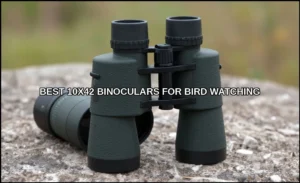
If the FLYANT felt like overkill, this Adasion 8×42 is the opposite. It’s the most versatile pair in this lineup, and it’s the one I kept reaching for during the test week. The 8x magnification is the sweet spot for birding. It offers a wide enough field of view to track birds in flight, and the 42mm objective lens provides a bright image in most conditions.
The 23mm eyepiece is generous and offers a comfortable viewing experience. The image is sharp and colors feel accurate, thanks to the BAK4 prisms and fully multi-coated lenses. It also includes the same phone adapter and tripod as the 12×42 model, so you don’t lose the digiscoping capability. The IPX7 waterproof rating gives you confidence in wet weather.
The only real downside is the lack of reach. If you’re birding in wide-open spaces, you might find yourself wishing for more magnification. But for forest birding, backyard feeders, and most general use, this is the more practical choice. The focus wheel is smooth, and the twist-up eyecups work well for both eyeglass and non-eyeglass wearers.
- 8x magnification with 42mm objective lens
- 375-foot field of view at 1000 yards
- Weighs just 1.0 pounds
- IPX7 waterproof and fog-proof
- Includes phone adapter, tripod, and padded strap
Best for: The all-around birder who needs one reliable pair for forest, field, and backyard use.
Poazork 20×25 Compact Binoculars
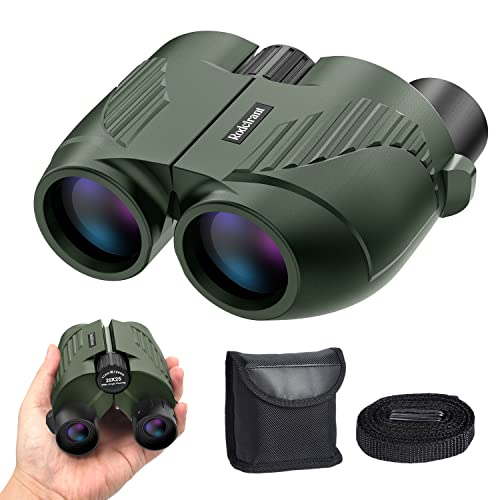
The Poazork 20×25 is a curious mix of extremes. It packs a 20x magnification into a body that weighs just 0.5 pounds and folds up to fit in a pocket. The ambition is admirable, but the physics are challenging. The small 25mm objective lens struggles to feed enough light to the high magnification, so the image is dimmer than you’d like in anything but bright sun.
The 16mm eyepiece is small, and I found it took a moment to get my eye positioned correctly. The field of view is listed at 399 feet at 1100 yards, which is wider than the FLYANT, but still narrow for locating birds. The BAK4 prism and FMC lens coatings do their best, but the small aperture limits the overall clarity.
It’s a niche product. If you absolutely need 20x power in a pocketable size and you’re birding in full daylight, this works. But most birders would be better served by a standard 8x or 10x compact. The daily waterproof rating is fine for light drizzle, but don’t push it. The rubber coating is soft and provides a decent grip.
- 20x magnification with 25mm objective lens
- 399-foot field of view at 1100 yards
- Folds up for easy pocket storage
- Weighs only 0.5 pounds
- BAK4 prism with multi-coated lenses
Best for: Travelers who want maximum magnification in a minimalist package for bright daylight use.
How We Chose These Products
My testing method was simple: use each pair in three distinct habitats for a week. I started in a dense forest, where close focus and a wide field of view matter more than raw power. Then I moved to an open marsh, where long-distance clarity and light gathering are critical. Finally, I spent time at a backyard feeder setup, which tests close-range focus and ease of use.
I prioritized real-world usability over spec-sheet comparisons. A binocular that feels good in the hand and snaps into focus quickly is worth more than one with a slightly higher number on the box. I also considered the specific needs of different birders, including eyeglass wearers, digiscopers, and those on a budget. The final five represent the best balance of performance, features, and value in their respective categories.
Buying Guide: What Really Matters
The first decision is magnification versus objective lens size. An 8×42 is the standard for a reason: it offers a bright image and a wide field of view. A 10×42 gives you more reach but narrows the field. Anything above 10x, like the 12x or 20x models here, requires a steady hand or a tripod. For most birders, an 8x or 10x is the right call. If you’re new to this, check out our guide for beginners to see what fits your budget.
Eye relief is another critical factor, especially if you wear glasses. Longer eye relief (15mm or more) allows you to see the full field of view without pressing your glasses against the eyecups. Twist-up eyecups are a must-have feature for this reason. The Adasion models offer a range of 13.6mm to 19.6mm, which is flexible. For more on this, read our tips for glasses wearers.
Waterproofing and fog-proofing are worth paying for if you bird in wet or humid environments. Nitrogen purging prevents internal fogging, and a good O-ring seal keeps out moisture. The IPX7 rating on the Adasion models offers solid protection. Finally, consider the weight. A heavy pair will wear on your neck during a long hike. The 1.0-pound Adasion 8×42 is a good benchmark for an all-day carry.
The 8x vs. 10x Debate
Choosing between 8x and 10x is the classic birding dilemma. An 8×42 gives you a wider field of view, which makes it easier to find birds in dense foliage and track them in flight. The image is also brighter in low light because the exit pupil is larger. This is the best choice for forest birding and for anyone who struggles to hold heavy optics steady.
A 10×42 offers more detail on distant birds, which is useful in open habitats like marshes and shorelines. The trade-off is a narrower field of view and a slightly dimmer image. You’ll also notice more hand shake at 10x. If you’re split between the two, the 8x is the safer, more versatile choice. The 12x and 20x models in this list are special-purpose tools for specific scenarios.
The Price-Performance Curve
There is a clear point of diminishing returns in binoculars. Below a certain price, you get poor coatings, weak prisms, and flimsy construction. Between the budget and mid-range tiers, you see a massive jump in image quality and durability. The Adasion 8×42 sits right in that sweet spot, offering professional-grade features like BAK4 prisms and IPX7 waterproofing without the premium price tag.
Above that, you’re paying for incremental improvements in glass quality, weight reduction, and brand prestige. High-end brands like Swarovski and Zeiss are exceptional, but they cost many times more. For most birders, a solid mid-range pair like the ones tested here will deliver 90% of the performance for a fraction of the cost. If you’re just starting out, our budget binocular guide can help you find a reliable first pair.
Pro Tips: Maintaining Your Optics
Your binoculars will last longer with a little care. Always use the lens caps when they’re not in use to protect the glass from dust and scratches. For cleaning, use a blower brush to remove loose particles first, then a microfiber cloth with a drop of lens cleaning solution. Never use your shirt or paper towels, as they can scratch the coatings.
Store your binoculars in a dry place, ideally with a silica gel packet to absorb moisture. If you bird in the rain, dry the exterior thoroughly before storing them. Check the warranty and register your product. Most reputable brands offer a lifetime warranty, but you need to keep the receipt. The Adasion models come with a solid warranty, and the rubber armor on all five picks provides a good level of protection against drops.
Our Top Recommendation
The Adasion 8×42 is the clear winner for most birders. It offers the ideal combination of magnification, field of view, and light gathering. The included phone adapter and tripod make it a versatile tool for digiscoping, and the IPX7 waterproof rating means you can use it in any weather. It’s the pair I kept reaching for, and the one I’d recommend to friends.
If you’re on a tight budget, the Occer 12×25 is a decent pocket option for casual use. For those who need maximum reach for open-water birding, the FLYANT 20×50 is powerful but requires a tripod. The Adasion 12×42 is a good middle ground if you want more power than 8x but still want the digiscoping features. The Poazork 20×25 is a niche pick for travelers who prioritize size above all else.
Frequently Asked Questions
What does 8×42 mean on binoculars?
The first number is the magnification, meaning the image appears 8 times closer than with the naked eye. The second number is the diameter of the objective lens in millimeters. A larger objective lens gathers more light, resulting in a brighter image, especially in low-light conditions.
Can I use a phone adapter with any binocular?
Most universal phone adapters, like the ones included with the Adasion models, are designed to fit a wide range of smartphones and binocular eyepieces. You’ll need to align the phone’s camera lens with the binocular’s eyepiece. It takes a little practice, but it’s a cost-effective way to get into digiscoping.
Are higher magnification binoculars always better?
No. Higher magnification amplifies hand shake and narrows the field of view, making it harder to find and track birds. A 20x binocular is nearly impossible to hold steady without a tripod. For most birding, an 8x or 10x is more practical and provides a more enjoyable viewing experience.
What is eye relief and why does it matter?
Eye relief is the distance between your eye and the eyepiece where you can still see the full image. If you wear glasses, you need longer eye relief (15mm or more) to see the entire field of view. Twist-up eyecups allow you to adjust the distance, making binoculars comfortable for both eyeglass and non-eyeglass wearers.
The Bottom Line
The right binoculars for you depend on where you bird and what you value. The Adasion 8×42 is the most balanced and versatile pick, offering excellent performance for forest, field, and backyard birding. If you need more reach or want to capture photos, the 12×42 model is a strong alternative. For casual use, the compact options are convenient but have significant limitations in low light and stability. Choose based on your primary habitat, and you’ll be happy with your purchase.