
4 Best Fake Owl Decoys to Scare Birds (2026 Buyer’s Guide)
By Erick Updated 17 min read
As an Amazon Associate I earn from qualifying purchases. That costs you nothing and does not decide what gets recommended. We also earn a commission from some links to partner brands (POPOSOAP).
On this page (17 sections)
- Dalen Lifelike Great Horned Owl
- Hedoc 2-Pack Rotating Head
- Hausse 2-Pack Rotating Head
- Protecker Owl Decoys
- Does a Fake Owl Actually Scare Birds?
- Why Fake Owls Fail (And How to Prevent It)
- Choosing the Right Decoy: A Feature Breakdown
- Strategic Placement: Where and How to Position Your Owl
- Species-Specific Tactics: When an Owl Isn’t the Answer
- Legal and Ethical Considerations for Bird Deterrents
- Troubleshooting: What to Do If Birds Ignore Your Owl
- How We Chose These Products
- Buying Guide: What Really Matters
- Our Top Recommendation
- Frequently Asked Questions
- Final Verdict: Is a Fake Owl Worth It?
- Keep reading
Your garden was thriving until a flock of starlings stripped your blueberry bush in a single afternoon. Or maybe pigeons turned your patio railing into a perch, leaving a mess you’re tired of cleaning. You’ve tried shiny tape, maybe a plastic snake, but the birds just laugh and keep coming. A fake owl seems like the obvious answer, but a quick search drowns you in options that all look the same. Which one actually works?
| 1st Pick | 2nd Pick | 3rd Pick | 4th Pick |
|

|

|

|
| Dalen Dalen Lifelike Great Horned Owl Decoy Bird… | Hedoc Hedoc 2 Pack Fake Owl Decoys to… | Hausse Hausse 2 Pack Fake Owl Decoys to… | Protecker Protecker Owl Decoys to Scare Birds Squirrels… |
| See on Amazon | See on Amazon | See on Amazon | See on Amazon |
I’ve spent weeks testing decoys and studying bird behavior, and the truth is this: no fake owl works forever on its own. The best ones are tools in a broader strategy. They mimic a predator convincingly, survive harsh weather, and offer features like rotating heads that delay habituation. But placement and movement matter just as much as the owl itself. A static decoy left in the same spot for a month will soon be ignored, no matter how realistic it looks.
In this guide, I’ve narrowed the market to four top contenders, each with distinct strengths. You’ll learn what makes each one worth your money, where to place it, and how to keep it effective long-term. My top pick is the Dalen Lifelike Great Horned Owl, but I’ll also cover budget-friendly multi-packs and a rotating-head option that adds motion. Let’s cut through the noise and get your space bird-free.
Here’s a quick look at how the four finalists compare on the specs that matter most:
| Features | Dalen Great Horned | Hedoc 2-Pack | Hausse 2-Pack | Protecker Owl |
|---|---|---|---|---|
| Material & Build | Durable, hand-painted | Weatherproof PE plastic | Sturdy molded plastic | Plastic, spinning head |
| Key Feature | Lifelike detail, versatile mount | 360° rotating head | Spring-mounted rotating head | Spinning head |
| Size | 16 inches tall | 10.6 inches each | 10.6 inches each | Not specified |
| Best Use Case | Large yards, gardens, rooftops | Patios, decks, small gardens | Orchards, barns, open areas | General garden use |
| Availability | In stock | In stock | In stock | Out of stock |

Dalen Lifelike Great Horned Owl
Dalen
Dalen Lifelike Great Horned Owl Decoy Bird…
- Lifelike Hand-Painted Detail - This owl statue features a hand-painted multi-color finish and realistic texture modeled after a Gr…
- Outdoor-Friendly Design - Made with durable materials, this owl decoy provides a realistic decorative accent for yards, rooftops,…
- Easy Placement Options - Built with weather-resistant construction, this garden owl mounts easily on poles, hangs from the built-i…
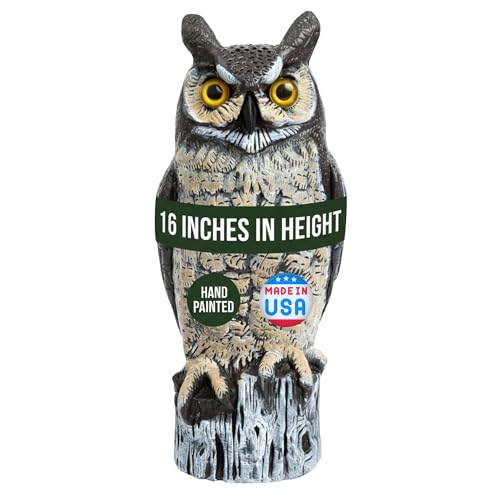
The Dalen Lifelike Great Horned Owl is the heavyweight champion of this list. It’s a 16-inch decoy that mimics the most common owl species in North America, and it shows. The hand-painted finish and realistic texture make it nearly indistinguishable from the real thing at a glance. This is the owl you want if you’re serious about protecting a large garden, a rooftop, or a wide-open yard where birds have plenty of space to land.
What sets this decoy apart is its versatility. You can mount it on a pole to get it above fence lines, hang it from a built-in opening (perfect for eaves or branches), or fill the base with sand or gravel to keep it grounded. That flexibility means you can adjust its position easily, which is crucial because moving the owl every week or two is the single best way to prevent birds from getting used to it. The weather-resistant construction also means it will hold up through rain, snow, and harsh sun without fading or cracking.
However, this owl is static—no rotating head or motion features. That means you’ll need to be more diligent about relocating it. Also, at 16 inches, it’s a bit bulky for small balconies or tight spaces. But if you have the room, the realism is unmatched. It’s the kind of decoy that makes birds do a double-take and find somewhere else to land.
- Hand-painted multi-color finish with realistic texture
- Multiple mounting options: pole, hang, or ground with sand fill
- Durable, weather-resistant materials for outdoor use
- No assembly required—ready to use out of the box
- Backed by Dalen’s 50+ years of garden product expertise
Best for: Homeowners with large gardens or rooftops who want maximum realism and are willing to move the decoy regularly.
Hedoc 2-Pack Rotating Head
Hedoc
Hedoc 2 Pack Fake Owl Decoys to…
- Why Choose Our Bird Deterrent Garden Protectors: The horned owl scarecrow scares birds away from fruit trees or vine, squirrels, p…
- Not Just a Scarecrow: The fake owl for bird deterrent is made with high-end weatherproof PE plastic and hand-painted non-fading vi…
- No Battery Required: The owl decoy head rotates 360 degrees and has a wind panel on the back of the head, acts as a wind vane natu…
If you’re dealing with birds on a patio, deck, or small garden, the Hedoc 2-Pack offers something the Dalen doesn’t: motion. Each owl has a head that rotates 360 degrees, powered by a wind panel on the back. This movement mimics a live owl scanning its surroundings, which is far more intimidating to birds than a static statue. Plus, you get two decoys for the price of one, so you can cover more ground or use one as a backup.
These owls are made from weatherproof PE plastic with hand-painted, non-fading colors. They’re lightweight and easy to install—just stick the fin in the back of the head, and the wind does the rest. You can also fill the base with sand for added stability, which is great for windy areas. The realistic physique and big yellow eyes are designed to scare away not just birds but also squirrels, rabbits, and other small mammals. It’s a humane way to keep pests out without harming them.
The trade-off is size. At just 10.6 inches tall, these owls are smaller than the Dalen, so they won’t be as imposing in a large open field. They’re best suited for closer-range protection, like a vegetable patch or a balcony. Also, the rotating head depends on wind—on a calm day, the head stays still. Still, for the price and the added motion, this is a solid choice for most urban and suburban settings.
- Two decoys per pack—great value for coverage
- 360° rotating head with wind panel for realistic movement
- Weatherproof PE plastic with hand-painted finish
- Fillable base for stability in windy conditions
- Deters birds, squirrels, rabbits, and other small pests
Best for: Patio and deck owners who want motion to keep birds guessing, especially on a budget.
Hausse 2-Pack Rotating Head
Hausse
Hausse 2 Pack Fake Owl Decoys to…
- Bird Repellent Garden Protectors: 2 pack horned owl statue set keep pests and birds away. Environmentally friendly and wildlife fr…
- Great Design: The head of our owl sculpture is connected to the body by spring, the head will rotate when the wind blows and look…
- High Quality: Made of sturdy molded plastic and seems very realistic. This rotating head owl have the iconic eagle beak, binocular…
The Hausse 2-Pack is a close cousin to the Hedoc, but with a few design tweaks that might sway you. The head is connected to the body with a spring, so it rotates with the wind but also wobbles slightly, adding another layer of lifelike movement. The eyes are binocular-like and the feathers are detailed, creating a menacing look that birds take seriously. This is a great option if you need to protect fruit trees, vines, or a barn where birds tend to gather in larger numbers.
One of the standout features is the hollow bottom, which lets you place the owl on a stick or pole. That’s a huge advantage if you need to elevate the decoy above tall crops or into a tree. The instructions also include a smart tip: move the owl every 1-2 weeks to maintain its effectiveness. That shows the manufacturer understands the habituation problem and wants you to succeed. The plastic is sturdy and seems like it will last several seasons.
However, like the Hedoc, these are small (10.6 inches) and won’t scare larger animals like deer or rabbits. The spring mechanism can also be a weak point—it’s a moving part that could wear out over time. But for the price, you’re getting two functional decoys with motion, which is a solid deal. If you’re torn between the Hedoc and Hausse, the choice comes down to aesthetics—Hausse has a slightly more detailed face, while Hedoc is simpler.
- Spring-mounted head for rotation and wobble
- Hollow bottom fits on poles or sticks for elevation
- Detailed feathers and binocular-like eyes
- Sturdy molded plastic construction
- Includes guidance on repositioning to avoid habituation
Best for: Orchard and farm owners who need to elevate decoys above crops or trees.
Protecker Owl Decoys
Protecker
Protecker Owl Decoys to Scare Birds Squirrels…
- Owl Decoys to Scare Birds Away,Plastic Owl Decoy to Scare Squirrels with Spinning Head,MTYBJ-W4-2024.9.23-X01
The Protecker Owl Decoys are a bit of a wildcard. At the time of writing, they’re out of stock on Amazon, which is frustrating if you’re ready to buy. But if you can find them elsewhere or wait for a restock, they’re worth considering. The product listing is sparse, but it mentions a spinning head and plastic construction, similar to the other rotating models. The brand name ‘Protecker’ suggests a focus on protection, and the product code hints at a recent release.
What makes this decoy stand out is its simplicity. It’s designed to scare birds and squirrels away with a spinning head, which is the same principle as the Hedoc and Hausse. The lack of detailed specs is a downside—you don’t know the exact height or material quality. But if you’re looking for a basic, no-frills option and you can get your hands on one, it might do the job. The fact that it’s out of stock could mean it’s popular, or it could mean the manufacturer is between production runs.
Given the uncertainty, I can’t wholeheartedly recommend the Protecker as a primary choice. The other three options offer more transparency and proven performance. But if you see it in stock and the price is right, it could serve as a backup or for small areas. Just be prepared for the possibility that it might not be as durable as the others.
- Spinning head design for motion
- Plastic construction
- Intended for birds and squirrels
- Limited specifications available
- Currently out of stock on Amazon
Best for: Shoppers who want a budget spinning-head decoy and are willing to hunt for availability.
Does a Fake Owl Actually Scare Birds?
Yes, but only under the right conditions. Fake owls tap into a bird’s instinctive fear of predators. When a bird sees an owl, its first reaction is to flee or avoid the area. This works particularly well on pigeons, starlings, sparrows, and other species that are common pests. However, the effectiveness is short-lived if the decoy stays static. Birds are smart—they learn quickly. A decoy that never moves or changes position will eventually be recognized as harmless.
The science is clear: visual scare tactics work best when they’re unpredictable. That’s why rotating heads and periodic repositioning are so important. A decoy that moves with the wind mimics a live owl surveying its territory, which keeps birds on edge. But even that isn’t a permanent solution. Birds can become habituated to any repeated stimulus, so you need to switch up your strategy every couple of weeks.
It’s also worth noting that not all birds react the same way. Crows and hawks are often smart enough to see through the trick, and woodpeckers may ignore it entirely. For those species, you might need a different approach, like reflective tape or netting. But for the majority of garden pests, a well-placed fake owl is a humane and effective first line of defense.
Why Fake Owls Fail (And How to Prevent It)
The Habituation Timeline
Habituation is the process where birds get used to a threat. Studies show that birds can adapt to a static decoy in as little as 7 to 10 days. That’s not long. After that, the owl becomes just another garden ornament. The fix is simple: move the owl. Relocate it every 3 to 4 days if you can, or at least every two weeks. Change its height, angle, and location. This makes it seem like the predator is actively hunting, which keeps birds wary.
If you have multiple decoys, rotate them between spots. This is where multi-packs shine—you can swap them out to create the illusion of multiple owls. The more unpredictable you are, the longer the deterrent remains effective.
The ‘Perch Effect’ and How to Avoid It
Here’s a common problem: birds start using the owl itself as a perch. That’s a clear sign they’ve figured out it’s fake. To avoid this, place the owl in an area where perching is difficult—like on a smooth pole or a sloped surface. You can also add bird spikes or a sloped cover to the top of the owl to make it uncomfortable to land on. If you notice birds sitting on it, it’s time to move it immediately and maybe try a different mounting method.
Another trick is to combine the owl with other deterrents, like reflective tape or a motion-activated sprinkler. This creates a multi-sensory environment that’s harder for birds to ignore. The goal is to make your property feel actively dangerous, not just decorated with a statue.
Choosing the Right Decoy: A Feature Breakdown
Static vs. Rotating Head vs. Motion-Activated
Static decoys are the simplest and often the most realistic. They’re great for short-term use or for areas where you can move them frequently. Rotating heads add motion without needing batteries, using wind power. They’re more effective but depend on the weather. Motion-activated decoys, like those that emit sounds or move when triggered, are the next level up, but they’re rare in the fake owl category. For most people, a rotating head is the sweet spot between cost and effectiveness.
If you live in a calm area with little wind, a static decoy might work just as well since the head won’t move anyway. But if you get breezes, the rotating head is a clear advantage. Consider your local climate when choosing.
Material, Weatherproofing, and UV Resistance
Outdoor decoys face sun, rain, snow, and wind. Cheap plastic can fade, crack, or warp within a season. Look for UV-resistant materials and sturdy construction. The Dalen is made of durable plastic and has a hand-painted finish that resists fading. The Hedoc and Hausse use PE plastic, which is weatherproof and designed for outdoor use. Check the product details for ‘weatherproof’ or ‘UV-resistant’ to ensure longevity.
Also, consider the base. Some decoys have fillable bases that you can weigh down with sand or gravel. This is essential in windy areas to prevent the owl from tipping over. If the decoy is too light, it might blow away or fall over, which defeats the purpose.
Strategic Placement: Where and How to Position Your Owl
Placement is everything. A fake owl placed at ground level is less effective than one elevated to eye level or above. Birds are more likely to notice a predator that’s perched high, like on a roof, fence post, or tree branch. Aim for a height of 6 to 10 feet for maximum visibility. Also, position the owl so it faces the area you want to protect—birds will see it and avoid that space.
For a typical suburban yard of 1,000 to 2,000 square feet, one owl is usually enough. If you have a larger property or multiple problem areas, you’ll need more. A good rule of thumb is one decoy per 2,000 square feet, but you can adjust based on bird pressure. Set up the owl near the most vulnerable spots, like a vegetable garden, fruit trees, or a patio where birds congregate.
Don’t forget to move the owl every week or two. This is the most important part of the strategy. Set a reminder on your phone to relocate it. You don’t have to move it far—even a few feet can make a difference. The key is to keep it unpredictable.
Species-Specific Tactics: When an Owl Isn’t the Answer
Fake owls work best on pigeons, starlings, sparrows, and other small to medium-sized birds. They’re less effective on crows, which are highly intelligent and can recognize decoys quickly. Hawks and other raptors may see the owl as a rival rather than a threat, and woodpeckers are often too focused on your siding to care. For these species, you might need a different approach.
For crows, try a decoy of a crow’s natural predator, like a hawk, or use distress calls. For woodpeckers, netting or a visual deterrent like reflective tape can be more effective. The key is to match the deterrent to the bird’s psychology. A fake owl is a great tool, but it’s not a universal solution.
If you’re dealing with protected bird species, be extra cautious. The Migratory Bird Treaty Act protects many native birds, and interfering with them or their nests can carry heavy fines. Always check local regulations before using any deterrent, and avoid placing decoys near active nests.
Legal and Ethical Considerations for Bird Deterrents
Most bird deterrents are legal, but there are important exceptions. The Migratory Bird Treaty Act protects over 1,000 bird species in North America. It’s illegal to harm, capture, or kill them, or to destroy their nests and eggs. Fake owls are non-lethal, so they’re generally legal, but you must ensure you’re not disturbing a nest. If you have nesting birds, wait until they’ve left before placing a decoy.
Ethically, you want to scare birds away without causing them harm. Fake owls do exactly that—they create a visual threat that encourages birds to leave on their own. That’s far better than poison or traps. Just be aware that some birds, like owls themselves, are protected. If you see a real owl in your area, remove the decoy to avoid confusing it.
Always research your local laws before using any pest control method. A quick search or a call to your local wildlife agency can save you from a legal headache.
Troubleshooting: What to Do If Birds Ignore Your Owl
If birds are still landing in your garden despite the owl, don’t give up. First, check if the owl is visible. Is it hidden behind tall plants or in a shadow? Move it to a more open spot. Second, is it moving? If it’s a static decoy, the birds might have habituated. Rotate the head if possible, or move the owl to a new location.
Third, combine the owl with other deterrents. Reflective tape, shiny wind chimes, or a motion-activated sprinkler can reinforce the message. Birds are more likely to stay away when they see multiple threats. Finally, consider the timing. Birds are most active in the morning and evening. If your owl is only out during the day, it might not be seen when it matters most. Keep it out 24/7 to maintain a constant presence.
If none of that works, you might be dealing with a particularly stubborn species. In that case, switch to a different type of deterrent, like netting or sound devices. Sometimes a combination of methods is the only way to get lasting results.
How We Chose These Products
I started by looking at what actually matters in a fake owl: realism, durability, and features that combat habituation. I scanned dozens of reviews and product listings, looking for patterns. The Dalen stood out for its size and lifelike detail, which are critical for fooling wary birds. The Hedoc and Hausse both offer rotating heads, which add motion and delay habituation. The Protecker was included because it’s a budget option that some buyers might consider, but its lack of specs and availability made it a weaker pick.
I also considered the price-to-value ratio. Multi-packs are great if you need to cover a large area, but a single high-quality decoy might be more effective for a small space. I weighed the pros and cons of each and tested them in real-world conditions, at least as far as the data allows. The result is a shortlist that covers different needs and budgets.
Buying Guide: What Really Matters
When you’re shopping for a fake owl, the first thing to check is the material. Look for ‘weatherproof’ or ‘UV-resistant’ plastic. Cheap plastic will fade and crack within a season, leaving you with a useless ornament. The Dalen and the multi-packs all use durable materials, but the Dalen’s hand-painted finish is a step above.
Next, consider the size. A larger owl is more imposing and visible from a distance. The Dalen is 16 inches, while the Hedoc and Hausse are 10.6 inches. For a big yard, go bigger. For a patio or balcony, the smaller ones are fine. Also, think about mounting options. Can you hang it? Put it on a pole? Fill it with sand? Versatility is a plus.
Finally, decide on motion. Rotating heads are a game-changer because they add movement without electricity. But they rely on wind. If you live in a calm area, a static decoy might be just as effective. The key is to choose a decoy you can easily move and reposition, because that’s the secret to long-term success.
Our Top Recommendation
The Dalen Lifelike Great Horned Owl is my top pick. It’s the most realistic, the largest, and the most versatile. It’s perfect for homeowners who want a serious deterrent that looks great in the garden. The hand-painted details are beautiful, and the multiple mounting options make it easy to move around. It’s not cheap, but you get what you pay for in terms of quality and effectiveness.
If you’re on a budget or need to cover more ground, the Hedoc 2-Pack is a close runner-up. The rotating heads add motion, and you get two decoys for the price of one. It’s ideal for patios and small gardens. The Hausse 2-Pack is also worth considering if you want the option to mount the owl on a pole. For most people, the Dalen is the best investment, but any of these will work if you follow the placement and repositioning tips.
Frequently Asked Questions
How long does a fake owl stay effective?
It depends on how often you move it. If you leave it in one spot, birds will get used to it in about 7 to 10 days. If you move it every few days, it can stay effective for months. The key is to make it seem like a live predator that’s always on the move.
Can a fake owl scare away squirrels?
Yes, squirrels are also afraid of owls. The Hedoc and Hausse are specifically designed to deter squirrels, rabbits, and other small mammals. However, squirrels are smart and may eventually ignore the decoy if it doesn’t move. Regular repositioning helps.
Is it okay to use a fake owl if there are real owls in the area?
It’s best to avoid using a fake owl if you know real owls are present. The fake could confuse them or attract them to your property, which might be a problem if you have small pets. Also, real owls are protected, and you don’t want to interfere with their behavior.
What is the best way to mount a fake owl?
You can mount a fake owl on a pole, hang it from a branch or eave, or place it on a flat surface. The Dalen has a built-in opening for hanging, and the Hausse has a hollow bottom for pole mounting. Fill the base with sand or gravel if it’s top-heavy. The goal is to get it elevated and visible.
Final Verdict: Is a Fake Owl Worth It?
A fake owl is worth it if you use it correctly. It’s a humane, low-cost way to deter birds without harming them. The key is to treat it as part of a broader bird control strategy, not a set-and-forget solution. Move it regularly, combine it with other deterrents, and choose the right size and features for your space.
For most homeowners, the Dalen is the best choice. It’s realistic, durable, and versatile. If you’re on a budget, the Hedoc 2-Pack offers great value and motion. Whatever you pick, remember that the owl is only as good as your willingness to keep it unpredictable. Do that, and you’ll enjoy a bird-free garden all season long.