
Selling backyard eggs: the flock size where it pays
By Erick Updated 10 min read
As an Amazon Associate I earn from qualifying purchases. That costs you nothing and does not decide what gets recommended. We also earn a commission from some links to partner brands (POPOSOAP, Kiwibit Inc.).
On this page (10 sections)
- The short version
- What you need before you run the numbers
- How many eggs a laying hen actually produces per year
- Feed cost per hen per year, and what that makes a dozen cost
- Hidden costs: the coop, bedding, winter and your time
- The egg price needed per dozen to break even
- How many chickens to make egg sales profitable
- Legal and practical limits on selling backyard eggs
- Common mistakes that keep egg sales unprofitable
- Questions people still ask
In short: For most US backyard keepers, selling eggs becomes genuinely profitable at roughly 15 to 25 hens. Below about 8 hens, the money you make just offsets your own feed-and-breakfast costs, because coop amortization and fixed extras eat the margin on small volumes.
Part of our guide on best electric fence for chickens
Nobody ranking for this question has ever divided a feed receipt by a carton count – here are the actual break-even numbers at every flock size.
| Profitable flock size | 15-25 hens |
|---|---|
| Feed per hen per year | About 90 lb |
| Feed cost per dozen | About |
| Break-even at 3 hens | About per dozen |
| Break-even at 20 hens | About per dozen |
| Realistic first-year lay | 220-250 eggs |
The short version
- A hen realistically lays 200-250 eggs her first year, not 300-plus
- Feed costs about $2.50-$2.90 per dozen at any flock size
- Fully costed break-even runs $4-$5/dozen at 3 hens, $3-$3.50 at 20+
- Local retail eggs at $5-$7/dozen make a 15-25 hen flock genuinely profitable
- Small flocks mostly offset household egg costs – that is a fine outcome
- Check your state's egg sales rules before you sell a single carton
What you need before you run the numbers
You cannot figure out your break-even from wishful thinking. You need four real figures, and every one of them comes from something you can check in an afternoon: your feed price, your hens' actual lay rate, your local egg price, and what you spent on housing.
Gather these before reading further. Guessing the lay rate at 300 eggs a year is the single biggest way keepers fool themselves into a losing venture.
If you want the ongoing math done for you, an app such as Flock Keeper, which we make, logs daily egg counts and feed spending and calculates cost per dozen for you – $24 one-time, designed for flocks under 15 birds. A spiral notebook does the same job, just slower.
- Feed receipt: your actual price per 50 lb bag of layer feed
- Lay log: eggs collected per week for at least a month
- Local price check: farm-stand and grocery prices for a dozen large eggs
- Coop receipt or build cost, plus an estimate of how long it will last
- A digital kitchen scale to weigh a typical daily feed ration

Etekcity Food Kitchen Scale
Weighs a full day's feed ration for your flock in 1 g steps on a 5 kg platform, so you can turn feed weight into your real cost per dozen eggs.
How many eggs a laying hen actually produces per year
Breed marketing will tell you a good layer produces 300 eggs a year. Reality is lower. A healthy commercial-type hybrid such as a Golden Comet or ISA Brown lays about 250 eggs in her first year, a Heritage breed like a Rhode Island Red or Australorp manages 200-220, and production falls 10-15 percent each year after. It helps to understand earning income from 25 chickens before going further.
Winter matters too. Below roughly 14 hours of light, most hens slow down or stop unless you add supplemental lighting. A hen in a cold-climate flock without lights may effectively produce for 9-10 months of the year.
For honest planning, use 220 eggs per hen per year as your working average for a mixed flock. That is 18.3 dozen. Plug that figure into every calculation below – if your real log shows better, great, but plan on the conservative number.
Feed cost per hen per year, and what that makes a dozen cost
A laying hen eats roughly a quarter pound of layer feed per day, about 90 pounds per year. A 50 lb bag at the current typical price of $20-25 covers a hen for about seven months, so call it $40-45 of feed per hen per year. The other half of this decision is how much do appenzellar chickens sell.
Divide that by her 18 dozen eggs: $45 divided by 18.3 dozen is roughly $2.45 per dozen in feed alone. Free-ranging cuts this somewhat – birds foraging good pasture can drop intake by 10-20 percent – but kitchen scraps are not free feed. Scraps mostly supplement; hens still need balanced layer feed to lay reliably.
Now add the per-hen extras: oyster shell for calcium, grit, and occasional electrolytes or vitamins. Budget about $1.50-2.50 per hen per year. That pushes the real cost of a dozen eggs to roughly $2.60-2.90 before you count the coop, bedding, or your time.
| Flock size | Dozen eggs per year | Feed + extras per year | Cost per dozen (feed only) |
|---|---|---|---|
| 3 hens | 55 dozen | $160 | $2.90 |
| 6 hens | 110 dozen | $315 | $2.86 |
| 12 hens | 220 dozen | $630 | $2.86 |
| 20 hens | 366 dozen | $1,050 | $2.87 |
| 25 hens | 458 dozen | $1,315 | $2.87 |
Hidden costs: the coop, bedding, winter and your time
Feed is the visible cost. The invisible ones decide whether selling pays. Start with the coop: a $800 coop and run that lasts eight years costs $100 a year. Spread across a 3-hen flock's 55 dozen, that is $1.80 per dozen. Spread across 20 hens' 366 dozen, it is just 27 cents. For the detail, see our notes on finding good chicken buyers.
Bedding runs $5-15 per month for a small coop, perhaps $60-100 a year. Replacement hens matter as well: if you replace every hen every three years, add roughly $8-10 per year per hen in stock cost. And winter slowdown means spring and summer sales must carry the months when the cartons are half empty.
Then there is your time. Collecting, washing, cartoning and delivering 366 dozen a year is real work – call it 60-80 hours annually at a 20-hen scale. At a fair $15/hour that is nearly $1,000, which is exactly why most backyard operations should treat their own labor as a cost the household absorbs, not a wage to be paid.
The egg price needed per dozen to break even
Here is the whole article in one table. Fully costed break-even price per dozen – feed, extras, bedding, coop amortization and hen replacement included – at your local retail price of $5-7 for comparison. It helps to understand how many chickens qualify for exemption before going further.
Notice the shape of it. Feed cost per dozen barely moves with flock size, but the fixed costs collapse as you spread them across more eggs. That is why flock size, not feed shopping, is what changes the economics.
- Multiply hens by 18 dozen to get annual production
- Multiply hens by $47 for feed and extras, and add $85 for bedding
- Add your annual coop cost (build price ÷ expected years of life)
- Divide the total by dozens produced to get break-even per dozen
- Compare against local farm-stand price to see your real margin
| Flock size | Dozen/year | Feed + bedding + coop per dozen | Break-even price | Margin at $6/dozen |
|---|---|---|---|---|
| 3 hens | 55 | $4.70 | $4.70 | $0.72/dozen |
| 6 hens | 110 | $3.75 | $3.75 | $2.47/dozen |
| 12 hens | 220 | $3.35 | $3.35 | $2.89/dozen |
| 20 hens | 366 | $3.15 | $3.15 | $3.08/dozen |
| 25 hens | 458 | $3.10 | $3.10 | $3.12/dozen |
How many chickens to make egg sales profitable
The verdict from the table: margin genuinely appears at roughly 15-25 hens. At 20 hens, break-even sits near $3.15 per dozen and a $6 local price earns about $3 per dozen across 366 dozen – around $1,100 a year against out-of-pocket costs. At 25 hens you can also sell to a steady customer list instead of whichever neighbor is home.
Below eight hens, no price rescues the economics, because coop and bedding costs land on too few cartons. That is fine – a 4-hen flock that sells a dozen a week to a coworker is simply offsetting your household egg bill, which is a perfectly good reason to keep chickens.
The real ceiling is not economics but demand. Twenty hens at peak lay produce 3-4 dozen a day. Before scaling up, count the customers you can honestly supply weekly: neighbors, coworkers, a farm stand, a local restaurant or two. Eggs unsold at $6 a dozen are still $3 of feed you never recover.
- 15-25 hens spread fixed costs thin
- Steady surplus supports regular customers
- Feed bought in bulk by the pallet drops cost further
- Enough volume to cover winter slump from summer sales
- Needs 3-4 dozen sold every week in season
- Requires real predator-proof run space
- Hen replacement costs arrive every 2-3 years
- Neighbor-scale demand often caps you below 25 hens
Legal and practical limits on selling backyard eggs
Most US states allow on-farm or direct-to-consumer egg sales from small flocks without a license, but the details vary by state and sometimes by city. Common rules cover clean, uncracked eggs kept at or below 45°F, honest labeling of size and an unpackaged or cartoned state, and some states cap sales by flock size before a permit kicks in.
Check your state agriculture department's cottage food or egg sales page, plus your county extension office. If you sell through a store, farmers market or restaurant instead of direct, expect inspection and licensing requirements. Selling from home to neighbors is nearly always the simplest route.
Practical limits matter as much as legal ones. Cartons run 35-50 cents each if you buy new, and delivery rounds eat evenings. And confirm demand before the hens arrive – a surplus you cannot sell at $6 makes your break-even price irrelevant.
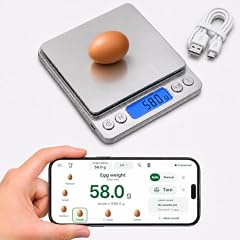
Super Egg Scale – Egg Sizing, Sizes, Grading, Egg Weight Analysis, reflex
Weighs each egg at 0.1 g resolution and grades sizes from small to jumbo through its app, so cartons for sale carry honest size labels.
Common mistakes that keep egg sales unprofitable
- Planning on 300 eggs per hen -> use 18 dozen per hen per year and adjust after a real season of records
- Counting only feed as a cost -> add bedding, coop amortization and hen replacement to your break-even
- Buying chicks in spring and expecting eggs by summer -> first eggs arrive around 5-6 months, full lay later
- Selling at grocery-store prices -> farm-fresh eggs earn $5-8/dozen locally; price on the local market
- Ignoring winter slowdown -> bank summer sales and customers against the November-February gap
- Skipping the lay log -> without weekly counts you cannot tell if a hen has quietly stopped earning her feed
Selling backyard eggs becomes genuinely profitable at 15-25 hens; smaller flocks offset household costs, which is still a win.
Questions people still ask
How many hens do I need to sell eggs and actually make money?
Roughly 15-25 hens. At 20 hens producing about 366 dozen a year, fully costed break-even is around $3.15 per dozen, leaving about $3 per dozen of margin against a $6 local price. Smaller flocks can sell eggs, but the money mostly offsets household costs.
What does it cost to feed one laying hen per year?
About $40-45 in layer feed, since a hen eats roughly 90 pounds a year. Add $1.50-2.50 for oyster shell, grit and extras, so call it $45-48 per hen per year all-in.
Is selling eggs profitable with just 3-4 chickens?
Not in the business sense. Fully costed break-even at 3 hens runs about $4.70 per dozen, and total annual profit at a $6 price is around $70. That is a household offset, not an income, and for most backyard keepers that is exactly the right goal.
Do I need a license to sell eggs from my backyard flock?
In most states, direct sales of clean, properly stored eggs from a small flock to individuals need no license, but rules vary. Some states require permits above a flock-size threshold or for sales through markets and stores. Check your state agriculture department and county extension before selling.
How much should I charge for a dozen backyard eggs?
Price against your local farm-stand market, typically $5-8 per dozen for large brown eggs. Know your own break-even – roughly $3.15/dozen at 20 hens – and never price below it even for friends.
How many eggs will 20 chickens lay per week?
Expect 6-8 dozen a week from 20 hens during spring and summer peak lay, dropping to 2-3 dozen in winter without supplemental lighting. Over a year, plan on about 366 dozen total for the flock.