Master Cockatoo Recall: Train Your Bird to Fly to You on Command

June 21, 2025 ·13 min read

You know the scene. The front door opens a crack, a gust of wind sneaks in, and your cockatoo launches off your shoulder like a feathered missile. Panic sets in as you watch them circle the neighborhood, screaming your name, while you stand helpless on the porch. It’s a nightmare scenario that plays out far too often with this species.

Most parrot training advice treats all birds the same. That’s a mistake with cockatoos. They are clingy, loud, and prone to hormonal mood swings. They also hate being told what to do. A generic recall method built for a budgie will fail with a cockatoo. This guide gives you a protocol built around their specific psychology: their need for control, their sensitivity to tone, and their love of drama.

Manoai

Bird Perch Stand with Clip, Adjustable Clip-On…

  • Natural Bird Perches: Natural Wood Bird Cage Perch Made of natural wood, this bird cage perch offers textured surface for comforta…
  • Multi functional and adjustable design: Adjustable Clip-On Design Flexible gooseneck allows angle adjustment. Sturdy clip fits mos…
  • Natural Bird Perches: Bird perches for cages are made of 100% natural apple wood. The natural coarseness of the branches provides…

You’ll walk away knowing how to build a rock-solid recall from the ground up. We’ll cover the pre-flight safety checks, a four-phase training method, how to fix the common problems like fly-bys and shoulder landings, and how to create an emergency recall that could save your bird’s life. No fluff, just a system that works.

Before you start, consider your bird’s comfort. A stable, natural perch makes a huge difference during training sessions. A recall training session is easier when your bird feels secure. The Manoai Bird Perch Stand clips onto the cage and gives your cockatoo a textured, non-slip landing spot that’s separate from your hand. It’s handy for the target training phase, giving your bird a consistent station to fly to.

master cockatoo recall train your bird to fly to you on command

Why Recall Training Is Non-Negotiable for Cockatoos

Cockatoos are not like other parrots. They form intense, almost obsessive bonds with their favorite person. That clinginess is exactly why recall training matters. A bird that only feels safe on your shoulder is a bird that panics when you’re not there. A bird trained to fly to you on command knows that you are a safe landing zone, no matter the distance.

This training is also about control. Cockatoos are smart and they need to feel like they have a say in what happens. Forcing a bird onto your hand often leads to a bite. Teaching them to fly to you turns the interaction into a choice. They decide to come. That decision builds trust faster than any amount of forced handling.

There is a persistent myth that recall training encourages biting or dominance. It’s nonsense. Recall is a cooperative behavior. The bird flies to you because good things happen when they do. You are not forcing submission; you are creating a partnership. A cockatoo that willingly flies across a room to land on your hand is not trying to dominate you. They are choosing to be with you.

Pre-Flight Checklist: Health, Wings, and Environment Safety

Do not skip this section. Training a bird to fly when it’s physically unable or in an unsafe space is a recipe for injury. You need to check three things before you start.

Assessing Your Cockatoo’s Flight Readiness

First, get a vet check. A healthy bird flies differently than a sick one. Respiratory issues or feather damage will affect their ability. You want a clean bill of health before you ask for physical exertion.

Second, look at the wings. If your bird is clipped, you need to wait for the next molt cycle. Flight feathers grow back in stages. You need at least four or five full primary feathers on each wing for a bird to steer properly. A bird with uneven wings will crash. If you are unsure, have your avian vet assess the feather condition.

Third, check your bird’s weight. A cockatoo that’s overweight will tire quickly. You can monitor this with a kitchen scale. Weigh your bird every morning before breakfast. A sudden weight drop of more than 10% is a red flag and a reason to pause training.

Setting Up a Safe Indoor Training Zone

Pick a room with no open windows or uncovered mirrors. Close the door. Cover any ceiling fans. These are non-negotiable. A cockatoo flying into a spinning fan is a tragedy you can prevent.

Remove other pets from the room during training. A dog barking at a flying bird will destroy your bird’s focus and create a negative association with flight. You want a quiet, boring room with no distractions. Start in a small space, like a bathroom or hallway, before moving to a larger living room.

Think about landing surfaces. Hard floors are dangerous for a bird learning to land. A bird that misjudges a landing will hit the floor. Put down a rug or a towel in the training area. This gives them a softer crash pad and builds confidence.

The Step-Up Foundation: The Prerequisite for Flight

You cannot teach recall to a bird that won’t step up on command. The step-up is the base behavior. It teaches your bird that moving to your hand is safe and rewarding. If your bird is hand-shy or bites when you approach, fix that first.

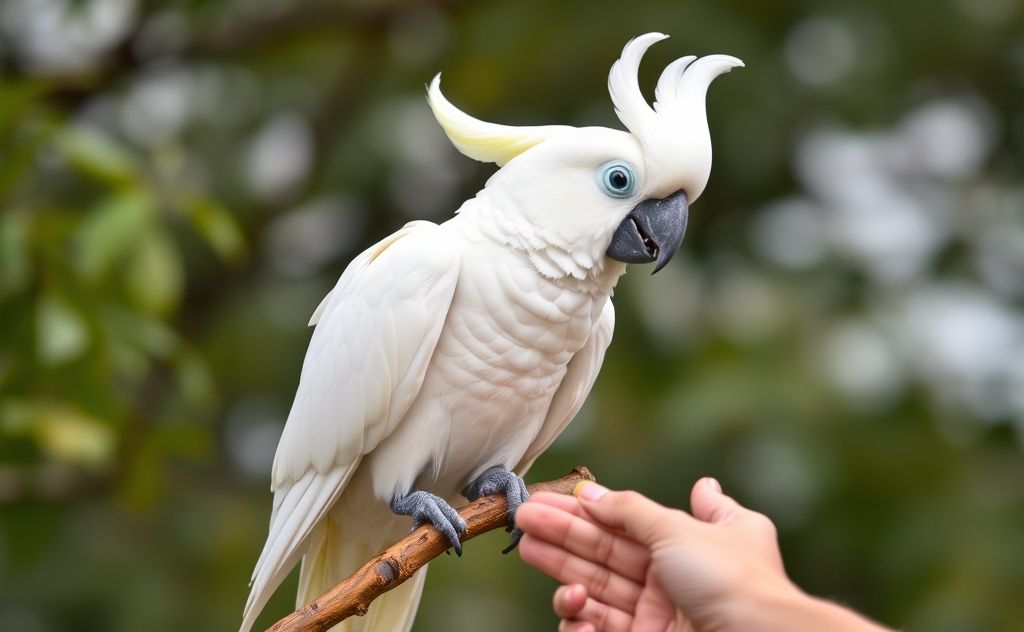
Use positive reinforcement. Hold a high-value treat in one hand and present your other hand as a perch. Say ‘step up’ in a calm, even tone. Do not grab the bird. Wait for them to place one foot on your hand, then give the treat. Repeat this until the behavior is fluid. The goal is a bird that steps up without hesitation, even when they are distracted.

Your hand position matters. Offer your hand at belly level, not above the bird’s head. A hand coming from above looks like a predator. A hand at belly level is a perch. This is a subtle but critical detail that most people get wrong.

The 4-Phase Recall Training Method

This is the core system. Each phase builds on the last. Do not rush. A bird that masters each step will have a solid, reliable recall. A bird that is rushed will develop bad habits like ignoring the cue or flying to your head.

Phase 1: Target Training and the Bridge

You need a target stick and a clicker. A chopstick or a wooden dowel works fine. The clicker is your bridge. It marks the exact second your bird does the right thing. The click is always followed by a treat.

Start by presenting the target stick a few inches from your bird’s beak. The moment they touch it with their beak or foot, click and treat. Repeat this ten times. Then move the target stick a little further away. Your bird will chase it. This teaches them to follow the target. It is the foundation of moving your bird around the room without touching them.

You are building a conditioned response. The click sound becomes a promise of a reward. This is critical for recall because it allows you to mark the behavior from a distance. You cannot click and treat at the same time if your bird is ten feet away. The click bridges that gap.

Phase 2: Short-Distance Flapping (Stationary to Hand)

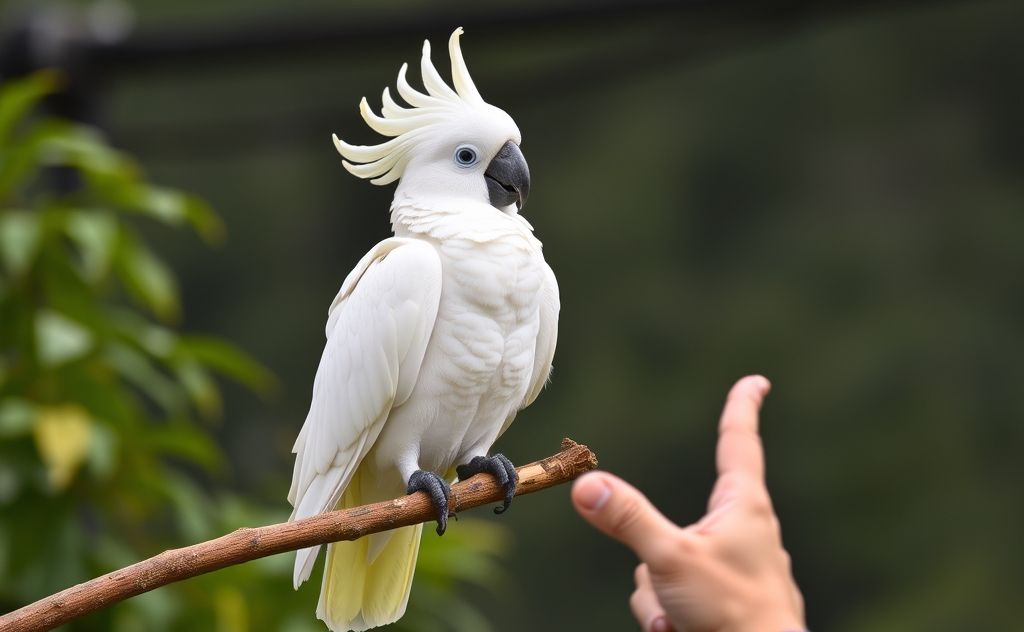
Now you ask for flight. Place your bird on a perch or the back of a chair. Stand directly in front of them, about one foot away. Show them the target stick or a high-value treat. Give your step-up command and encourage them to come to you.

At this distance, many cockatoos will simply hop or take a short flap. That’s fine. Click and treat the moment they leave the perch. Reward the attempt, not the perfect landing. You want them to associate moving toward you with a reward.

Gradually increase the distance. Move from one foot to two feet, then three. Keep the sessions short, around five minutes. End on a successful repetition. If your bird refuses to fly at a certain distance, step closer and try again. Do not push them past their comfort zone.

Phase 3: Increasing Distance and Adding the Cue

Once your bird is flying three to four feet consistently, start adding the verbal cue. Say ‘come’ or ‘here’ just as your bird launches from the perch. With repetition, your bird will associate the word with the action of flying to you.

Increase the distance to across the room. Add small variations to the environment. Move a chair. Place a toy on the floor. This teaches your bird to generalize the behavior. They learn that ‘come’ means ‘fly to my hand’ no matter what the room looks like.

This is also the stage where you start fading the target stick. Use the verbal cue and your hand as the primary signal. The target stick becomes a backup for when your bird is distracted. You want the cue to be the main driver.

Phase 4: The ‘Emergency Recall’ Protocol

This is the most important part of your training. A normal recall is for convenience. An emergency recall is for safety. It is a separate cue, like ‘come now’ or ’emergency’, that you use only in dangerous situations. It must be 100% reliable, no matter what.

To build this, you need an over-the-top reward. Something your bird only gets during emergency recall drills. Think sunflower seeds, a tiny piece of almond, or a favorite fruit. This reward is never used for any other behavior.

Practice emergency recall less frequently than normal recall, but with more drama. Call the emergency cue, and the moment your bird lands, they get the jackpot reward. The goal is to make this cue so powerful that your bird responds instantly, even if they are scared or distracted. This is the cue that gets your bird out of a tree or away from an open door.

Troubleshooting Common Cockatoo Recall Problems

Even with a solid plan, you will hit snags. Cockatoos are stubborn. Here is how to handle the most common issues.

The ‘Fly-By’ (Ignoring the Hand)

Your bird flies across the room but lands on a curtain rod or the top of a door instead of your hand. This is a classic problem. It usually means your hand is not a compelling enough landing spot.

Fix this by making your hand more rewarding. Hold a high-value treat in the hand you are presenting. Let your bird see it. Do not offer the treat until they have landed on your hand. If they fly past you, do not chase them. Simply walk away and try again from a shorter distance.

Another trick is to present your hand lower than your bird’s flight path. A bird will naturally land on the highest point. If your hand is below them, they will fly over it. Raise your hand to chest level, so it is the most obvious landing spot in the room.

The ‘Shoulder Hog’ (Landing on Head/Shoulders)

This is a cockatoo specialty. They love to be high up, and your shoulder is the perfect perch. The problem is that a bird on your shoulder is out of your sight line and can be dangerous if they get spooked.

You need to make your hand a better option than your shoulder. The moment your bird lands on your shoulder, gently but firmly bend forward at the waist. This makes your shoulder an unstable perch. At the same time, present your hand as a stable alternative. Say ‘step up’. When your bird moves to your hand, reward them with a treat and praise.

Consistency is key. Do not let your bird sit on your shoulder at any other time during training. If you allow it outside of training, they will not understand why it’s not allowed during a recall. You have to be strict about this boundary.

Refusal to Leave the Cage or Favorite Perch

Sometimes your bird just won’t leave their safe zone. This is a motivation problem. Your reward is not good enough, or your bird is tired.

Inspect your training treats. Are they actually high-value? A dry seed might be boring. Try a small piece of walnut or a bit of millet spray. You want something your bird would cross a room for.

Also check the session length. A five-minute session is plenty. If your bird is refusing after a few repetitions, they are likely bored or tired. End the session, give them a break, and try again later. Never force a bird to train when they are not interested. That creates a negative association.

Taking It Outside: Harness Training vs. Free Flight Risks

Outdoor recall is a different beast. The distractions are massive, and the risks are real. You should never attempt free flight with a cockatoo outdoors unless you have years of experience and a bird that is bombproof. Even then, accidents happen. A sudden gust of wind or a hawk can turn a routine flight into a tragedy.

Your safest option is a well-fitted harness. A harness allows your bird to experience the outdoors while staying physically connected to you. It takes time to get a cockatoo used to wearing one. Start indoors. Let them wear it for short periods while you offer treats. Do not force it on them all at once. Patience is essential.

If you are determined to work on outdoor recall, start in a fully enclosed space like a screened porch or a large aviary. Work on the same training phases you used indoors. Do not attempt open-air free flight. The risk is not worth it. A bird that flies off into a tree and refuses to come down is a bird that is likely to be lost forever.

For more on safe outdoor options, read about the best bird harness for recall training to understand the different types and how to fit them properly.

The Golden Rule: Never Call for Negatives

This is the single most important rule in recall training. Never call your bird to you to do something they dislike. If you call your bird and then immediately put them in their cage, clip their nails, or give them medicine, they will learn that coming to you leads to bad things. They will stop coming.

Always end a recall session with something positive. If you need to put your bird away, call them to you, give them a treat, then ask them to step onto a perch and walk them to their cage. Do not use the recall cue as a way to grab them.

This rule applies to every interaction. If your bird flies to you, even when you did not call them, reward them. You want to reinforce the behavior of coming to you, not just the behavior of coming when called. A bird that is always rewarded for landing on you will keep doing it.

Measuring Progress and Maintaining the Skill

You need a way to know if you are actually making progress. Do not just guess. Track your training sessions and set measurable goals.

Week Training Focus Success Criterion Session Length
1 Target training and clicker conditioning Bird touches target 10/10 times on cue 5 minutes, 2x daily
2 Short-distance flapping (1-3 feet) Bird flies to hand 8/10 attempts 5 minutes, 2x daily
3 Distance increase (5-10 feet) and verbal cue Bird flies to hand on verbal cue 8/10 attempts 7 minutes, 2x daily
4 Across-room recall and distraction proofing Bird flies from any perch to hand on cue 9/10 attempts 10 minutes, 1x daily
5 Emergency recall drills (jackpot rewards) Bird responds to emergency cue within 2 seconds, 9/10 attempts 5 minutes, 3x per week

Maintenance is just as important as the initial training. A recall is a skill that decays if you do not use it. Practice a few short recalls every day, even if it is just from one side of the room to the other. Keep the rewards random. Sometimes give a treat, sometimes give praise, sometimes give a head scratch. This unpredictability keeps your bird interested.

If you hit a plateau, go back to an earlier phase. There is no shame in re-teaching a behavior. A solid recall is a lifelong skill that requires regular upkeep. Think of it like a muscle. If you do not use it, you lose it.

Also, consider your bird’s living environment. A bird that spends all day in a small cage may not have the muscle strength for long flights. Give them time out of the cage to stretch their wings. A bird that gets regular flight practice will be a more confident and reliable flier. You can read more about what it means when birds fly in your house for a different perspective on indoor flight.

Finally, be patient. Some cockatoos take to recall in a week. Others take a month. Your bird’s temperament, history, and current trust level all play a role. Do not compare your progress to someone else’s. Focus on your bird and celebrate the small wins.

Here are the most important things to remember:

  • Never call your bird for a negative interaction. Protect the cue at all costs.
  • Use a clicker to mark the exact behavior you want, and always follow with a high-value treat.
  • Start indoors in a small, safe room. Remove all hazards like open windows and fans.
  • Build an emergency recall cue with a jackpot reward that is only used for that cue.
  • Fix fly-bys by making your hand the most appealing landing spot with a visible treat.
  • Do not allow shoulder landings during training. Make your hand the only option.
  • Practice daily, even for just a few minutes. A recall you do not use is a recall you will lose.