Binocular Prism Types: How They Impact Bird Watching
Contents
You’re standing at the edge of a marsh, and a warbler flits into view. You raise your binoculars, and the bird is a fuzzy blob. You adjust the focus, but the image stays soft. The problem might not be your eyes or the light. It could be the prisms inside your binoculars.
Prisms are the glass elements that fold the light path inside the body. They determine how sharp the image is, how bulky the binoculars feel, and how much you pay. This article explains the two main types — roof and Porro — and how each affects your birding experience. You’ll learn what the numbers on the spec sheet actually mean, and which style fits your specific needs.
occer
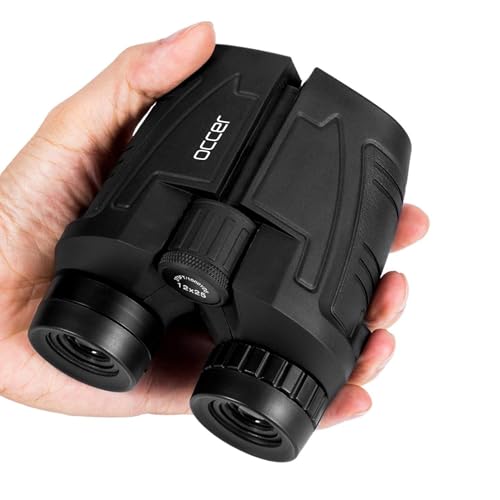
Occer 12x25 Compact Binoculars for Adults and…
- 【HIGH-POWERED LARGE EYEPIECE BINOCULARS】 This binoculars for adults has 12x magnification, 25mm objective lens and wide field of v…
- 【ADJUSTABLE EYE CUPS FIT EYEGLASS WEARERS OR NOT】The binocs can be pull down the rubber eyepieces and more fit the glasses wearer,…
- 【FMC BROADBAND COATING TECHNOLOGY】The lightweight cruise binoculars is cover with BAK4 prism texture. The objective lens use optic…
If you’re looking for a compact, budget-friendly option to start with, the Occer 12×25 Compact Binoculars uses BAK4 prisms and multi-coated lenses, which are the same core components found in more expensive models. It’s a solid entry point for casual birding or for a kid who wants to tag along.
Roof Prism Binoculars: The Modern Birding Standard
Roof prism binoculars have straight barrels. The objective lenses and eyepieces are aligned, which makes the body slim and compact. Most serious birders use this style because it’s easier to carry all day and feels balanced in the hand.
The trade-off is cost. A roof prism design requires more precise manufacturing. The internal surfaces must be coated to reflect light correctly, and the phase correction coating is essential. Without it, the image loses contrast and sharpness. Cheap roof prism binoculars often skip this coating, and you’ll notice a dull, hazy image, especially in low light.
Good roof prism binoculars also use dielectric or silver mirror coatings on the prism surfaces. These reflect more light than standard aluminum coatings. A pair with dielectric coatings can transmit 90-95% of light, while an uncoated pair might only pass 80%. In dense forest shade, that difference is huge.
Another benefit of roof prisms is water resistance. Because the body is sealed more easily, they tend to be better at keeping out moisture and fog. If you bird in the rain or near waterfalls, this matters.
My personal gripe with roof prisms is the narrow field of view on some models. You get a more compact body, but you might see a smaller area at 1000 yards. For tracking fast-moving songbirds, a wider field helps. Check the spec for field of view; aim for at least 300 feet at 1000 yards for birding.
Porro Prism Binoculars: Classic Design, Better Depth Perception
Porro prism binoculars have that classic offset shape — the objective lenses are wider apart than the eyepieces. This design is older but far from obsolete. Many budget-friendly and mid-range birding binoculars still use Porro prisms because they offer excellent image quality for the price.
Because the prisms are simpler to manufacture, you get a lot of performance for less money. A $150 Porro prism pair often outperforms a $150 roof prism pair in terms of brightness and sharpness. The wider spacing between the objectives also improves stereopsis, which is your brain’s ability to perceive depth. You’ll notice a more three-dimensional view when looking at branches and foliage.
The downside is size and weight. Porro prism binoculars are bulkier and don’t pack as easily into a jacket pocket. They also have exposed prisms that can get knocked out of alignment if dropped. If you’re hard on your gear, that’s a risk.
For birders who prioritize optical quality over compactness, Porro is a smart choice. The best Porro prism binoculars can rival high-end roof models at a fraction of the cost. I’ve used a pair of 8×40 Porros for years, and they still beat my newer roof pair on a cloudy morning.
Prism Glass: BAK4 vs. BK7
Prism glass type matters as much as the prism geometry. The two common types are BAK4 and BK7. BAK4 is a higher-grade glass with a higher refractive index. It transmits more light and produces a perfectly round exit pupil. BK7 is cheaper and often shows a square or cut-off exit pupil, which wastes light.
Look through the eyepieces at arm’s length against a bright sky. If you see a sharp, round circle of light, that’s BAK4. If you see a square with clipped corners, that’s BK7. The difference is noticeable in bright sunlight and even more so at dawn or dusk.
Most decent birding binoculars use BAK4, but some budget models cut corners. The Occer 12×25 mentioned earlier uses BAK4 prisms, which is a good sign at that price point. Always check the spec sheet for ‘BAK4’ and avoid anything that just says ‘prism glass’ without specifying.
There’s also a newer glass called SK15, which is similar to BAK4 but used in some Japanese-made binoculars. It’s rare and mostly found in high-end models. For 99% of birders, BAK4 is all you need.
How Prism Type Affects Eye Relief and Glasses
If you wear glasses, prism type influences how close you can get your eye to the eyepiece. This distance is called eye relief. Roof prism binoculars often have longer eye relief because the eyepiece design is more flexible. You need at least 15mm of eye relief to see the full field of view with glasses on.
Porro prism binoculars sometimes have shorter eye relief, especially in compact models. You’ll have to hold them further away, which makes the image smaller. If you wear glasses, check the eye relief spec before buying. A model with twist-up eyecups and 17mm of eye relief is ideal.
The Occer 12×25 has adjustable rubber eyecups that fold down for glasses wearers. That’s a practical feature for a budget model. For more options, check out this guide on binoculars for glasses wearers.
| Feature | Roof Prism | Porro Prism |
|---|---|---|
| Body Shape | Straight, compact | Offset, bulky |
| Image Brightness | Good, needs phase coating | Excellent for the price |
| Depth Perception | Standard | Enhanced (stereopsis) |
| Durability | Better sealed, water-resistant | Prisms exposed, alignment risk |
| Weight | Lighter | Heavier |
| Typical Cost | Higher for same quality | Lower for same quality |
| Best For | Hiking, travel, all-day carry | Backyard birding, budget buyers |
Choosing the Right Prism for Your Birding Style
Start with your environment. If you bird in open fields or along coastlines, you have plenty of light. A roof prism pair with phase coating will work well. If you bird in dense woods or early morning, you need maximum light transmission. A Porro prism pair with BAK4 glass is your friend.
Next, consider your neck. A heavy pair of Porros will fatigue you after a few miles. Roof prisms are easier to carry, but you’ll pay more for the same optical quality. I’d rather carry a 20-ounce roof pair than a 30-ounce Porro pair on a long hike.
Finally, think about budget. You can get a very good Porro prism pair for under $100. A comparable roof prism pair will cost twice that. If you’re just starting out, save money on the body and spend it on a good harness or tripod adapter. Check out some budget binoculars for birding if you’re price-sensitive.
Are roof prism binoculars always better than Porro?
No. Roof prisms are more convenient because they’re compact and easier to seal against moisture. But Porro prisms often deliver brighter, sharper images for the same price. If you don’t mind the extra bulk, Porro is a better value.
What does BAK4 prism mean?
BAK4 is a type of optical glass with a high refractive index. It allows more light to pass through the prism and produces a round exit pupil. BK7 glass is cheaper and produces a square exit pupil, which wastes some light. Look for BAK4 on the spec sheet.
Do I need phase correction coating on roof prisms?
Yes. Roof prisms split light into two paths, and phase coating corrects the interference between them. Without it, the image is softer and has lower contrast. Any roof prism binoculars without phase coating should be avoided for serious birding.
What is the best magnification for bird watching?
8x is the standard for most birders. It gives a wide field of view and steady image. 10x offers more detail but is harder to hold steady. 12x, like the Occer 12×25, is useful for long-distance viewing but requires a steady hand or a tripod.
Can I use Porro prism binoculars with eyeglasses?
Yes, but check the eye relief specification. You need at least 15mm of eye relief to see the full field with glasses on. Some Porro models have shorter eye relief, so try them before buying if possible.
What to Remember When Buying
- Choose BAK4 prisms over BK7 for brighter images.
- Roof prisms are compact but need phase coating to perform well.
- Porro prisms give better depth perception and value for money.
- Aim for at least 300 feet field of view at 1000 yards.
- If you wear glasses, look for 15mm+ eye relief.
- Weight matters — a heavy pair stays in the car, not on your neck.
- Test the exit pupil shape before buying if you can.