You’ve probably seen the viral videos. A parrot perfectly mimics a phrase or sings a song. It’s impressive, even startling. But it makes you wonder: is that just a clever party trick, or are they actually communicating? When two parrots are together, do they use those human words to talk to each other?
The short answer is yes, parrots absolutely talk to each other. But their conversation is nothing like ours. They use a complex system of natural vocalizations, body language, and learned sounds. To truly understand it, you need to look past the mimicry and into the world of flock dynamics and vocal learning.
How Parrots Naturally Communicate in the Wild
Forget human words for a moment. In their natural habitats, parrots are incredibly social and noisy. Their communication serves vital, practical purposes for survival and social bonding. It’s a constant stream of information.
These natural sounds, or parrot vocalizations meaning specific things, include:
- Flock Calls: Contact calls to maintain group cohesion while flying or foraging. A parrot might call out, “I’m here!” and listen for the response, “We’re over here!”
- Alarm Calls: Sharp, urgent sounds that signal immediate danger from predators.
- Food Calls: Excited chattering that draws the flock to a discovered food source.
- Aggressive Signals: Hisses, growls, and specific postures used in disputes.
- Courtship Sounds: Softer, more melodic vocalizations paired with specific dances.
So, how do parrots communicate with each other in the wild? It’s a rich, contextual language of sound and sight. An African Grey Parrot in the Congo rainforest uses different calls than a flock of Budgerigars in the Australian outback, but the principles are the same. Their communication is immediate, emotional, and tied directly to their environment.
Mimicry vs. Meaning: Do They Understand What They Say?
This is the core of the mystery. When your pet Amazon Parrot says “Hello!” when you enter the room, does it understand the word as a greeting? The relationship between mimicry and true understanding is nuanced.
Parrots are exceptional vocal learners. They can memorize and reproduce sounds from their environment, including human speech, other animals, and mechanical noises. They often use these learned sounds in context, which makes it seem like understanding.
For example, a parrot might learn that saying “Want a nut?” when you’re near the treat jar often results in getting a nut. It has associated the sound with a positive outcome, not necessarily because it understands the grammatical question. This is where training tools like the Getting Started Clicker can be useful. Clicker training helps bridge that gap by marking the exact behavior you want, allowing you to shape communication more clearly. It’s less about teaching human words and more about building a shared, understood signal.
So, do parrots understand what they say? With their own natural calls, absolutely. With human words, it’s more about associative learning. They learn that certain sounds produce certain results or reactions. Some high-intelligence species like the African Grey, however, have demonstrated a shocking capacity to use words referentially, labeling objects, colors, and numbers correctly. The line is blurrier than we once thought.
The Social Engine: Flock Communication and Bonding
Communication is the glue that holds a parrot flock together. Parrot social behavior is complex, involving lifelong partnerships, communal roosting, and cooperative rearing of young. Their vocal exchanges are constant.
In your home, your pet parrot sees your family as its flock. The chatter you hearwhether natural calls or mimicked phrasesis often an attempt to engage in this flock dynamics. When you leave the room and your parrot calls out, it’s performing a contact call. It’s checking in. When you “talk back,” you’re reassuring it that the flock is intact.
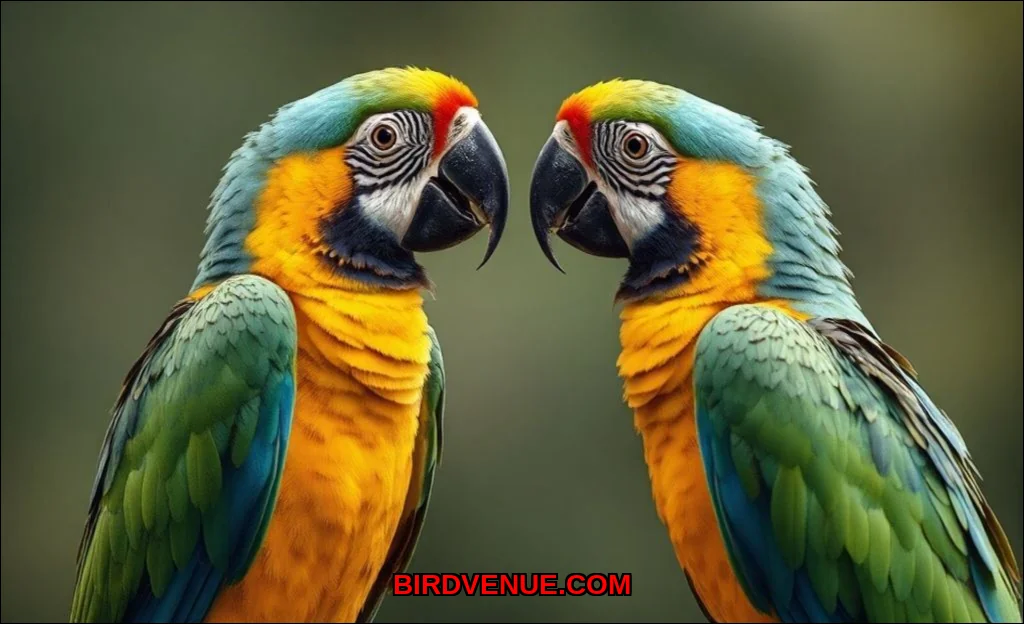
Do pet parrots talk to each other differently? If you house two parrots together, you’ll likely notice a fascinating shift. They will often revert to, or develop, a shared vocabulary of natural calls and whistles. They may also teach each other human words or sounds. Their communication with each other is typically more instinctual and less about performing for human approval. For insights into which species are most inclined to pick up this human-centric mimicry, explore our guide to the parrots that can talk the most.
The Science Behind the Sound: Vocal Learning Anatomy
What makes parrots, along with hummingbirds and songbirds, so special in the animal kingdom? It’s their advanced capacity for vocal learning. Most animals produce innate sounds, but few can learn new ones after hearing them.
Parrots achieve this with a specialized vocal organ called the syrinx, located where the trachea splits into the lungs. They have incredible control over the tiny syringeal muscles, allowing them to shape complex sounds. Neurologically, they possess a “song system” of interconnected brain nuclei that handle hearing, memorizing, and reproducing sounds. Recent research shows parrots have an additional, unique “shell” structure around this system, which may explain their superior mimicry skills compared to other avian intelligence standouts.
This places them in an elite group of vocal learners that includes dolphins, whales, elephants, and bats. It’s a rare and cognitively demanding trait.
How Parrot “Talk” Differs from Human Language
It’s tempting to equate our abilities, but human language and parrot communication are fundamentally different. Recognizing these differences helps you appreciate what your bird is actually doing.
| Human Language | Parrot Communication |
|---|---|
| Based on complex syntax and grammar rules. | Based on context, association, and emotion. |
| Infinite combinatorial creativity (discrete infinity). | Limited to learned repertoire and innate calls. |
| Primarily for sharing abstract ideas and information. | Primarily for social cohesion and immediate needs. |
| Involves a theory of mind and intent to share knowledge. | Debatable if it involves the same level of intentionality. |
So, can parrots have conversations with each other? Yes, but not in the human sense of exchanging novel ideas. Their “conversations” are exchanges of social signalsreassurances, warnings, invitations. How is parrot mimicry different from real communication? Mimicry is a tool they can use within their communicative framework. A parrot might mimic your laugh during play to share the mood, or mimic your “Goodnight” at bedtime as part of the routine. The mimicry meaning is embedded in the social moment.
Even smaller species are capable of this complex social chatter. If you’re considering a more compact companion, our list of small parrots that can talk details which smaller birds have big vocal talents.
Putting It All Together: Listening to Your Parrot
Now that you know the mechanics, you can become a better listener. Pay attention to the context of your parrot’s sounds. Is it morning? You’re likely hearing cheerful flock greetings. Did a stranger enter? That might be an alarm call. Is it quiet and you’re preparing food? That’s excited food chatter.
When your parrot uses a human word, ask yourself: what usually happens next? What is the emotion in the room? They are masters of reading atmosphere and using sound to interact with it. For a deeper dive into the evolutionary “why” behind this amazing ability, the scientific perspective offered by Britannica’s analysis on why parrots talk is an excellent resource.
Their ability to talk to each other is a profound, innate part of their being. It’s not about the words we teach them. It’s about the constant, vibrant dialogue of flock lifea dialogue they try to include you in every single day. By understanding their natural bird language, you don’t just hear noise. You hear connection.
