
So you’re thinking about a feathered friend. Maybe you’ve seen a stunning blue and gold macaw at a sanctuary or heard an African Grey perfectly mimic a laugh. The terms “macaw” and “parrot” get tossed around a lot, often interchangeably. But here’s the first key nuance: all macaws are parrots, but not all parrots are macaws. It’s a classic category vs. subcategory situation, like squares and rectangles.
Understanding this distinction is more than just taxonomy trivia. It directly impacts your lifeyour ears, your schedule, your budget, and your heart for decades. Choosing between a macaw and another parrot type means comparing a powerful sports car to the entire universe of automobiles. Both are incredible, but their demands and personalities differ wildly. For any large, active bird, space is a premium. That’s why many owners of sizable parrots invest in a spacious and secure habitat like the Extra Large Elegant cage, which provides the crucial room needed for climbing and wing-stretching.
Defining the Terms: Parrot Family vs. Macaw Genus
Let’s get our classifications straight. All parrots belong to the order Psittaciformes. This massive group includes over 350 species, from tiny budgies to massive hyacinth macaws. Within that order, you have the family Psittacidae, often called the “true parrots,” which encompasses most of the familiar species like Amazons, African Greys, and macaws.
Macaws are a specific genus within this family, scientifically labeled Ara (though a few species fall into other genera like Anodorhynchus). So when you ask, “are macaws parrots?” the answer is a definitive yes. They are a brilliant, often massive, subset. A more apt comparison might be macaw vs cockatoo, as both are distinct groups within the parrot order with very different care needs and personalities.
Taxonomic Classification & Differences
Think of it like this: Psittaciformes is the “country” (all parrots). Psittacidae is a “state” within that country (true parrots). And Ara is a specific “city” (macaws). Other “cities” include Cacatua (cockatoos) and Psittacus (African Greys). This parrot family classification helps explain why a scarlet macaw and an African grey parrot can both be incredibly intelligent talking birds, yet be as different as a lion and a wolf.
Side-by-Side Comparison: Size, Color, and Physical Traits
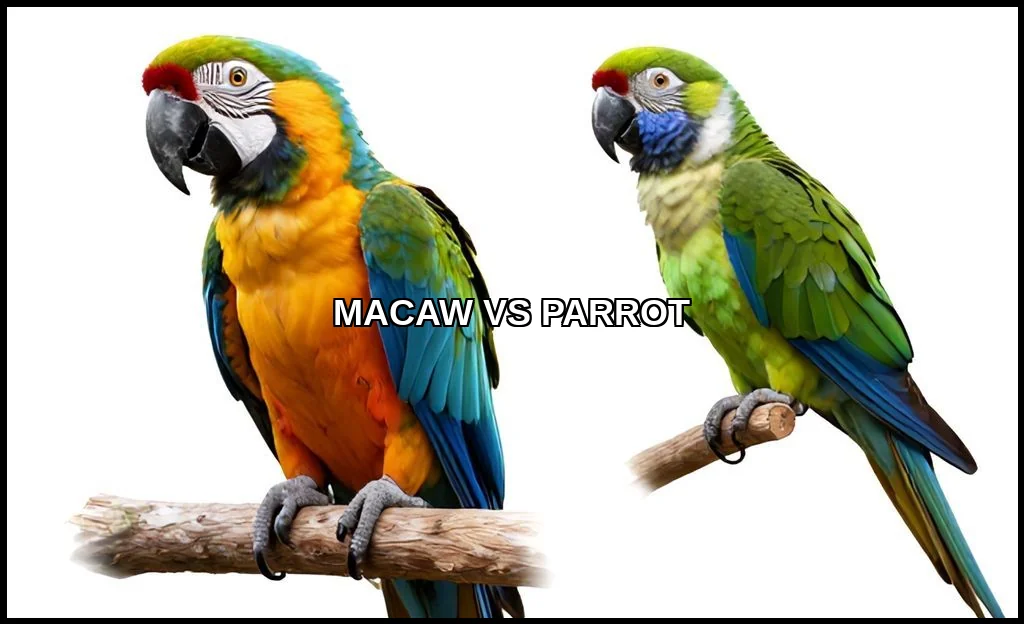
This is where the visual difference hits you. Macaws are the giants of the parrot world, with most species qualifying as large parrots. An African Grey, a large parrot itself, typically maxes out around 13 inches. A hyacinth macaw can stretch nearly 40 inches from beak to tail tip.
Physical Characteristics & Size Comparison
Let’s break it down with a quick table for clarity, focusing on some popular representatives.
| Trait | Macaw (e.g., Blue & Gold) | Other Large Parrots (e.g., African Grey) |
|---|---|---|
| Average Length | 30-36 inches | 12-14 inches |
| Key Feature | Long, tapered tail; bare facial patch | Short, square tail; all-feathered face |
| Beak | Massive, powerful enough to crack palm nuts | Strong, but more proportionate to head size |
| Color | Often vibrant, solid blocks of color (blue, red, green) | Primarily shades of grey with a red tail (Congo) |
That bare facial patch on macaws? It’s unique to them and a few other species. It blushes with excitement or agitation. Their stunning colors are a trade-off; in the jungle, those bright feathers blend into the colorful canopy. The scarlet macaw vs african grey contrast is a perfect study in evolutionary adaptation.
Behavior and Care: Noise, Intelligence, and Daily Needs
Now we get to the real heart of ownership. The physical size is one thing, but the behavioral footprint is another. Both groups exhibit profound avian intelligence, often compared to a young child. They solve puzzles, understand concepts, and form deep bonds. But how that intelligence manifests varies.
Behavior, Temperament & Noise Levels
Macaws are often described as “clowns.” They’re physical, goofy, and love to play with their massive beaks (which requires trust training). Their vocalizations are less about mimicry and more about powerful, natural calls. So, which is louder macaw or parrot? Generally, a macaw’s contact call is earth-shaking. It’s designed to travel miles in the rainforest.
African Greys and Amazons, conversely, are often the champion mimics. They excel at reproducing sounds, words, and the emotional tone behind them. You can explore more on which parrots talk in our dedicated guide. All parrots need immense mental stimulation. Boredom leads to screaming and feather-plucking.
Care Requirements: A Lifestyle, Not a Hobby
This isn’t casual pet ownership. It’s a lifestyle commitment. The cost of owning a macaw vs a smaller parrot is significant.
- Space: Macaws need a room-sized aviary or a cage the size of a small closet. They must be able to fully spread their wings.
- Diet: Not just seeds. Both require fresh vegetables, high-quality pellets, nuts, and fruits. Macaws need more fat (like whole nuts) for energy.
- Time: We’re talking 3-4 hours minimum of supervised, out-of-cage interaction daily. They are flock animals. Isolation is cruelty.
- Destruction: A macaw’s beak can dismantle furniture. A conure might chew a baseboard. Provide a mountain of appropriate, destructible toys. Regular vet visits with an avian specialist are non-negotiable.
Transport is part of care, too. Whether it’s a vet visit or a family trip, having a secure, comfortable carrier is key. For medium-sized birds like Meyers parrots, finding the best travel carrier can make all the difference in reducing stress.
Lifespan & Cost: The Long-Term Commitment
This is the most sobering part for potential owners. Parrots are arguably the longest-lived common pets. So, what is the lifespan of a macaw compared to a parrot? It’s a huge range.
- Large Macaws: 50-80 years. They often outlive their original owners.
- African Greys & Amazons: 40-60 years.
- Smaller Parrots (Cockatiels, Conures): 15-30 years.
The financial cost mirrors the lifespan. Initial purchase for a hand-raised macaw can run $1,000 to $3,000+. The cage, toys, and annual food/vet bills easily add another $1,000+ per year. For a deeper dive into the difference between parrot and macaw from a scientific perspective, this authority guide from Audubon is an excellent official source.
Choosing the Right Bird for Your Lifestyle
So, are macaws good pets for beginners? Almost universally, no. Their size, power, noise, cost, and lifespan make them a profound challenge. They require an experienced, patient, and deeply committed owner. A first-time bird owner is better suited to a cockatiel, a budgie, or even a conure to learn the ropes of pet bird care.
Choosing between macaw species and other parrot types comes down to brutal self-honesty.
- Assess your environment. Do you live in an apartment with thin walls? A macaw’s call will get you evicted.
- Audit your time. Can you provide several hours of engaged interaction every single day for decades?
- Calculate the real cost. Include future vet emergencies and a potential trust fund for the bird’s care in your will.
- Visit rescues. Talk to owners. Volunteer. The reality of living with a large, intelligent, messy, and emotional creature is the best education.
Both macaws and other parrots offer unparalleled companionship. They are emotional, witty, and deeply connective animals. The joy is immense. But the responsibility is staggering. Your choice shouldn’t be about the most beautiful bird, but the one whose needs you can meet fully for its entire, incredibly long life. That’s the true mark of a great bird owner.
