
Parrots are more than just colorful chatterboxes. They are masterpieces of evolutionary engineering, perfectly sculpted for survival across diverse and often challenging environments. Their vibrant feathers and playful antics are just the surface. Underneath lies a suite of remarkable adaptations that answer a core question: how do parrots adapt to their environment so successfully?
From the dense rainforests of the Amazon to the arid outback of Australia, parrots thrive. This success isn’t accidental. It’s the direct result of specialized physical traits, sharp intelligence, and flexible behaviors. These parrot survival features are a fascinating study in parrot biology and parrot evolution. For anyone curious about parrot characteristics, it starts with understanding these built-in tools for life. And for those living with these intelligent birds, providing mental stimulation is key. Offering a variety of engaging Bird Toys Parrot can mimic the foraging and problem-solving challenges they are evolutionarily primed for.
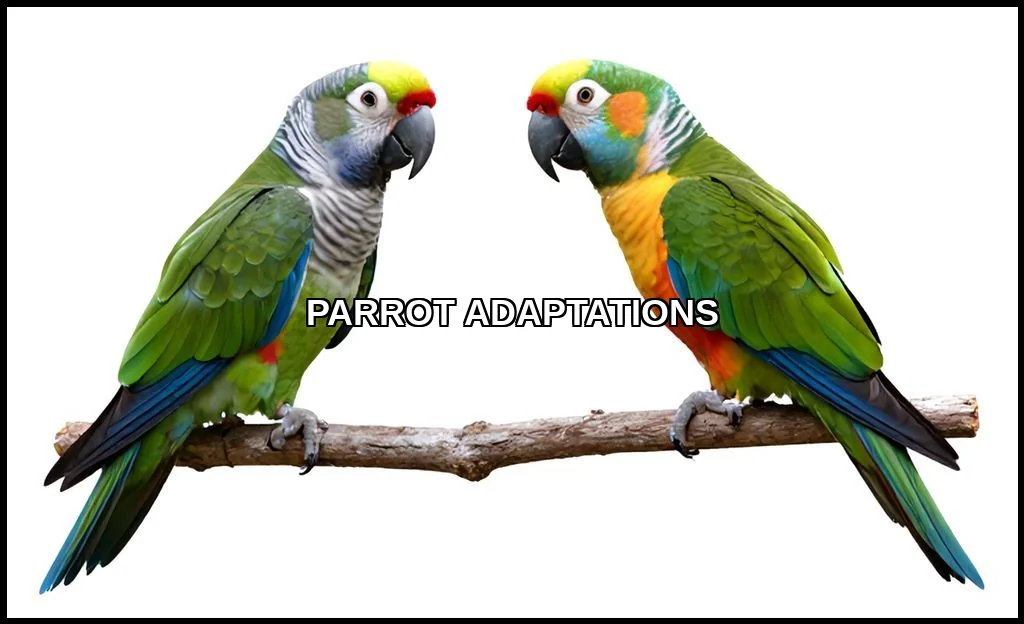
Physical Adaptations: Beaks, Feet, and Feathers
Parrot anatomy is a toolkit. Each part is specialized for a specific function, from feeding to flying to climbing. These physical parrot traits are the foundation of their daily existence.
The Ultimate Multi-Tool: Parrot Beak Adaptations
Why do parrots have curved beaks? It’s not just for cracking nuts. That powerful, hooked shape is a marvel of design. The upper mandible is hinged to the skull, allowing for incredible strength and dexterity. It functions as a third limb, a nutcracker, a preening comb, and a climbing hook all in one.
- Dietary Specialist: The beak’s shape varies by diet. Macaws have massive beaks for breaking palm nuts, while lorikeets have finer, brush-tipped beaks for nectar.
- Precision Grip: The tip is sensitive, allowing parrots to manipulate tiny seeds with surgeon-like precision.
- Climbing Aid: Parrots use their beak to grip branches, pulling themselves up as they climb. This is one of the key adaptations of a parrot for flying less and climbing more in dense canopy.
Zygodactyl Feet: A Perfect Grip
Look at a parrot’s foot. You’ll see two toes pointing forward and two pointing backward. This configuration is called zygodactyl feet. It’s a game-changer. This foot structure provides a vice-like grip on branches, allowing parrots to perch securely on the thinnest twigs, sleep without falling, and manipulate food with their feet like hands.
They can hold a piece of fruit, bring it to their beak, and eat comfortably. This frees the beak for other tasks. It’s a fundamental parrot feet adaptation for an arboreal lifestyle.
Feathers for Flight and Function
Flight feathers are strong and asymmetrical, providing the lift and thrust needed for powerful, agile flight through cluttered forests. But feathers aren’t just for flying. Down feathers provide insulation. The vibrant colors, often a result of unique feather structure rather than pigment, play roles in communication and mating. Some species even use cryptic coloration to blend into their surroundings, a subtle but effective survival tactic.
Behavioral Adaptations: Intelligence and Mimicry
Parrot intelligence is legendary and is a behavioral adaptation as critical as any physical trait. A large brain relative to body size supports complex problem-solving, social learning, and memory.
The Power of a Big Brain
In the wild, intelligence translates to survival. Parrots remember complex travel routes to seasonal food sources. They solve puzzles to access food, like figuring out how to open a tricky seed pod. This cognitive flexibility allows them to adapt to changing environments and new challenges, a key reason behind their global success as both wild and companion animals.
Mimicry as a Social Tool
Parrot mimicry is perhaps their most famous behavioral trait. In the wild, it’s deeply social. Flock members learn each other’s contact calls. Some evidence suggests mimicry can be used to integrate into a new flock or strengthen pair bonds. The famous ability to mimic human speech is an extension of this social learning skill. For a deeper dive into the neuroscience behind this, the official source from Audubon provides excellent detail. It’s less about understanding language and more about social bonding in a domestic setting. If you’re curious about which species excel at this, some are naturally more inclined vocal learners.
Dietary and Digestive Adaptations
A parrot’s parrot diet is often tough, fibrous, and sometimes even toxic. Their digestive system is specially adapted to handle this challenge and extract every bit of nutrition.
It starts with the beak and tongue, specialized for their chosen food. But the real magic happens inside. Parrots have a muscular pouch called a crop adaptation at the base of their neck. This allows them to store food quickly in a safe location, then digest it later at leisurea huge advantage when foraging in the open.
Their stomach is in two parts: the proventriculus for enzyme secretion and the gizzard, a muscular organ that grinds tough food, often with the help of ingested grit. A relatively long intestinal tract allows for the slow, thorough breakdown of plant matter. This entire system is a direct adaptation to a diet rich in seeds, nuts, fruits, and vegetation.
| Diet Type | Example Species | Key Adaptation |
|---|---|---|
| Seed & Nut Crackers | Macaws, Cockatoos | Extremely powerful, crushing beaks |
| Nectar Feeders | Lorikeets, Lories | Brush-tipped tongues, weaker beaks |
| Fruit Specialists | Many Amazon parrots | Strong, gripping beaks to hold and pierce fruit |
Habitat-Specific Adaptations and Conservation
Parrot habitat shapes form and function. A species living in a hot, dry climate has different needs from one in a humid rainforest. Understanding these parrot adaptations is now crucial for their conservation.
Examples from Around the Globe
- Rainforest Parrots: Often brightly colored for communication in dim light. Agile flight for navigating dense canopy. Strong feet for constant climbing.
- Ground Parrots (e.g., Kakapo): Flightless, with strong legs for walking and running. Cryptic coloration to blend into forest floor vegetation.
- Desert Parrots (e.g., Budgerigar): Lightweight bodies for long-distance flight to find water. Ability to withstand high temperatures and go long periods without water.
Why Adaptations Matter for Survival Today
Habitat loss and climate change are testing these ancient adaptations. A parrot evolved for a specific rainforest niche may not adapt quickly enough to deforestation. Specialized diets make some species vulnerable when food sources disappear. This is where human understanding and intervention become part of the survival equation. Providing safe transport for companion parrots, like finding the best travel carrier, is a modern application of caring for their well-being based on their physical needs.
Conservation isn’t just about protecting birds; it’s about protecting the intricate ecosystems that their adaptations are designed for. When we preserve a forest, we preserve the context for the parrot’s hooked beak, zygodactyl feet, and complex social calls.
So, how do parrot adaptations help them survive? In every way imaginable. They are a seamless integration of form and function, behavior and biology. The curved beak cracks food and climbs trees. The intelligent brain solves problems and forges social bonds. The specialized gut extracts life from tough meals. Each trait tells a story of evolutionary problem-solving. For these incredible birds, adaptation isn’t a concept. It’s their reality. And ensuring their future means respecting the delicate balance between their ancient design and our modern world.
