
Parrots are more than just colorful mimics. They are a global family of birds, with over 350 species, each sculpted by its environment. Their story is one of incredible adaptation, from the dense rainforests to arid savannas. Understanding their world is key to appreciating their complexity and ensuring their future.
Their survival hinges on a suite of specialized tools and behaviors. It’s a masterclass in avian ecology. For those caring for parrots at home, replicating aspects of their natural world is a constant goal. Products like the Natures Miracle Bird cleaner can be a practical part of that, helping manage the mess that comes with a vibrant, active bird in a domestic setting.
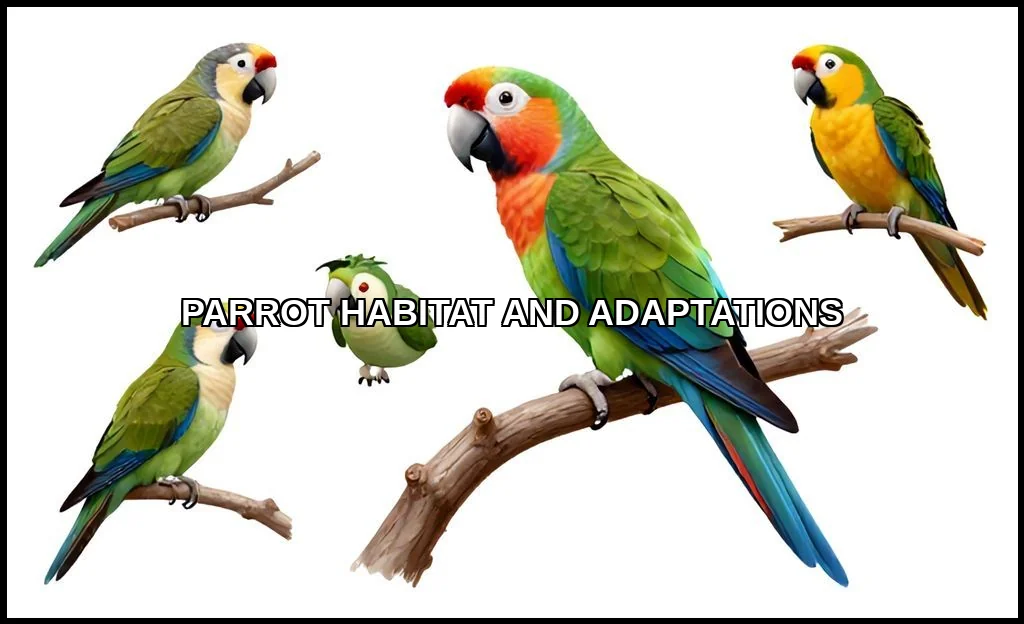
Parrot Habitats Worldwide: From Rainforests to Deserts
When you think “parrot,” you likely picture a rainforest habitat. This is accurate for many iconic species like macaws and Amazons. These tropical biomes offer year-round food, nesting cavities in tall trees, and a complex social landscape. But parrot species are habitat generalists in many ways.
You’ll also find them in:
- Savannas and Grasslands: Species like the Australian Galah thrive here.
- Arid Scrublands: The clever Kea of New Zealand’s alpine regions is a famous example.
- Coastal Mangroves: Some species, like certain lorikeets, specialize in these unique ecosystems.
This global distribution means their adaptations must be versatile. A one-size-fits-all approach doesn’t work in the parrot ecosystem. The core question of how do parrots survive in the rainforest has different answers for a parrot in the outback.
Key Physical Adaptations: Beaks, Feet, and Feathers
Parrots are engineering marvels. Their bodies are toolkits perfectly designed for their lifestyles.
The Multifunctional Beak
A parrot’s beak is its Swiss Army knife. The strong, curved shape is no accident. Why do parrots have strong curved beaks? It serves multiple critical functions:
- Feeding: It can crack the hardest nuts (a key parrot diet adaptation), slice through fruit, and delicately preen feathers.
- Climbing: The beak acts as a third foot, providing a powerful grip when scaling branches.
- Manipulation: It’s used for exploring objects, building nests, and even as a weapon in defense.
This is the essence of parrot beak function. It’s not just for eating; it’s integral to their mobility and interaction with the world.
Zygodactyl Feet: The Ultimate Gripping Tool
If the beak is one tool, their feet are another masterpiece. Parrots have zygodactyl feet. This means two toes point forward and two point backward. Think of it as having two opposable thumbs.
This configuration provides an unparalleled grip for:
- Securely perching on branches of any size.
- Manipulating food items with foot-to-beak coordination.
- Climbing and exploring vertical surfaces with ease.
It’s a fundamental tropical bird adaptation for life in the three-dimensional world of the forest canopy.
Feathers and Flight
Their vibrant plumage isn’t just for show. It provides camouflage among bright flowers and fruits. Underneath those feathers lies a powerful keel (sternum), a large breastbone where massive flight muscles anchor. This structure allows for the strong, direct flight needed to travel between feeding grounds and escape predators. Their intelligence even extends to which parrots can mimic sounds, a vocal adaptation linked to complex social learning.
Behavioral Adaptations: Social Structure & Intelligence
Parrot survival is a team sport. Their parrot behavior is as adapted as their physiology.
The Power of the Flock
Flocking behavior is their primary survival strategy. There’s safety in numbers. A large group has more eyes to spot predators like hawks or snakes. It also creates opportunities for social learningyoung birds learn what’s safe to eat by watching elders. This complex social structure is a cornerstone of their intelligence.
Within the flock, communication is constant. Their loud, raucous calls maintain group cohesion over long distances in dense forest. This social complexity is why isolating a parrot is so psychologically damaging; you’re removing its fundamental ecological context.
Cognitive Prowess
Parrots possess problem-solving skills rivaling great apes. They use tools, understand cause and effect, and have demonstrated self-awareness. This intelligence allows them to adapt to changing food sources and remember complex geographical layouts of their home range. It’s a behavioral buffer against environmental uncertainty.
Dietary Adaptations for Different Habitats
A parrot’s menu is dictated by its address. Their digestive systems and foraging behaviors are fine-tuned to local resources.
What adaptations help parrots eat nuts? It starts with that powerful beak, but continues internally. Many species have a muscular gizzard that, with the help of ingested grit, grinds down tough shells. Others, like lories and lorikeets, have specialized brush-tipped tongues for nectar feeding.
| Habitat Type | Primary Diet | Key Adaptation |
|---|---|---|
| Rainforest Canopy | Nuts, Seeds, Fruits | Extremely powerful beak, strong gizzard |
| Nectar-Rich Forests | Pollen, Nectar, Soft Fruits | Brush-tipped tongue, digestive enzymes for sugars |
| Ground-Feeding (e.g., Kakapo) | Leaves, Roots, Berries | Strong legs for walking, keen sense of smell |
This dietary flexibility is a huge advantage. When one food source fails, they can often switch to another. It’s a key reason they’ve colonized so many different biomes. For owners, choosing the best travel carrier for vet visits or trips is part of managing their specialized dietary and safety needs outside the home.
Human Impact and Habitat Conservation
Here’s the stark reality. Parrots face an anthropogenic crisis. Their brilliant adaptations are no match for the scale of human-driven change.
How does habitat loss affect parrots? It fractures everything. Deforestation for agriculture or logging destroys nesting sites and food sources. Isolated fragments of forest can’t support large, healthy flocks, disrupting social structures and genetic diversity. The illegal pet trade further decimates wild populations of the most desirable species.
Parrot conservation is now a race against time. Efforts are multi-pronged:
- Habitat Protection: Establishing and enforcing protected areas is non-negotiable.
- Community Initiatives: Programs that give local communities economic incentives to protect forests, like ecotourism, are gaining traction.
- Captive Breeding & Reintroduction: For critically endangered species, this is a last-ditch lifeline.
- Combating the Illegal Trade: Strengthening international laws and enforcement is critical.
Climate change adds another layer of threat, altering the very biomes they are adapted to. The niche they evolved for is shrinking or shifting faster than they can adapt.
Parrots are not just pets or pretty birds. They are sophisticated organisms, each featurefrom their zygodactyl feet to their complex flocking behaviortelling a story of evolutionary triumph. Their survival now depends on our actions. Protecting their habitats isn’t just about saving parrots; it’s about preserving the intricate ecological webs they anchor. The next time you hear a parrot’s call, remember it’s the sound of a highly adapted survivor. And its future is, unmistakably, in our hands.
