
Which metal travel cage fits your parrot for air travel
By Erick Updated 15 min read
As an Amazon Associate I earn from qualifying purchases. That costs you nothing and does not decide what gets recommended. We also earn a commission from some links to partner brands (POPOSOAP, Kiwibit Inc.).
On this page (8 sections)
- The short version
- Airline regulations for metal bird travel cages
- Minimum cage size and metal type for parrot air travel
- Features required for safe parrot air travel in metal cages
- How to measure your parrot to pick the right metal travel cage
- Metal carriers that pass airline inspection
- When metal carriers are the wrong choice
- Questions people still ask
In short: Choose a metal travel cage no larger than 18 × 11 × 11 inches for most US carriers, with ventilation on at least three sides, welded or riveted construction, and a spring-loaded door latch. Your parrot must stand upright without touching the top and turn around completely.
Most metal travel cages sold online fail airline rules because they lack four-sided ventilation or exceed the under-seat dimensions.

ORIZZP Bird Travel Carrier with Stand Perch
External height 16.5 inches, width 12.0 inches exceeds 11 inch max
Check it on Amazon| Product | Interior height (inches) | Verdict | |
|---|---|---|---|
| ORIZZP Bird Travel Carrier with Stand Perch ORIZZP | External height 16.5 inches, width 12.0 inches exceeds 11 inch max | Irrelevant due to size | View on Amazon |
| Suertree Bird Carrier Airline Approved Suertree | External height 10.8 inches, less than 12 inches needed | Short by 10% | View on Amazon |
| Max external size | 18 × 11 × 11 inches |
|---|---|
| Min ventilation | Three sides with openings |
| Interior height needed | 12 inches for medium parrots |
| Latch type required | Spring-loaded or twist bolt |
| Material | Welded or powder-coated steel |
| Cargo threshold | Parrots over 500g or 14 inches |
The short version
- US airlines require carriers no larger than 18 × 11 × 11 inches to fit under the seat in economy cabins
- Your parrot must stand fully upright and turn around inside the cage: measure from feet to head crest before buying
- Ventilation on at least three sides is mandatory; many budget carriers fail this and are rejected at the gate
- Spring-loaded or twist-bolt latches pass TSA inspection; simple hook latches are often flagged as insecure
- Metal carriers survive TSA handling better than soft-sided bags, which can collapse under stacked luggage
Airline regulations for metal bird travel cages
US airlines allow metal bird carriers in the cabin when they fit under the seat in front of you, which means external dimensions no larger than 18 inches long, 11 inches wide, and 11 inches tall for most economy seats. Delta, United, American, and Southwest publish these limits in their pet travel policies. Your carrier counts as your one personal item, so you cannot bring a separate bag unless you buy an extra seat.
The Federal Aviation Administration requires carriers to remain under the seat for taxi, takeoff, and landing. You cannot hold the cage on your lap or place it in the overhead bin. Airlines reserve the right to reject a carrier at the gate if it does not fit or if the door latch looks insecure.
International flights follow IATA Live Animals Regulations, which demand ventilation openings on at least three sides, each covering a minimum of 16 percent of that side's total area. Most US carriers adopt the same rule even for domestic flights. A cage with ventilation only on the front and back will be turned away. Four-sided ventilation is safer and eliminates arguments with gate agents.
TSA inspectors open your carrier during screening. Spring-loaded or twist-bolt latches are approved because they lock positively. Simple hook-and-eye or sliding bar latches without a locking mechanism are often flagged as escape risks. Your parrot will be hand-inspected or swabbed for explosives residue, so a top-loading door makes the process faster and less stressful for the bird. We cover cage for bird recovery in its own article.
Minimum cage size and metal type for parrot air travel
Your parrot must stand fully upright without its head or crest touching the top, and it must turn around without its tail feathers dragging or bending. Measure your bird from the bottom of its feet to the tip of its tallest feather when standing naturally. Add two inches of clearance to account for movement and stress posturing. A cockatiel standing 10 inches tall needs a cage with at least 12 inches of interior height.
Interior height is always less than the external dimension because of the floor pan and top frame. Most metal carriers lose 1 to 1.5 inches between external and usable interior height. A cage listed at 11 inches tall externally gives you about 9.5 to 10 inches inside, which is too short for most conures and small Amazons.
Length and width matter less than height because parrots tolerate close quarters for short trips, but they cannot crouch or hunch. Your bird should turn 180 degrees without tail contact with the sides. For a green-cheeked conure with a 6-inch body and 5-inch tail, an interior floor of 10 × 8 inches works. Smaller birds like budgies and lovebirds fit comfortably in carriers as compact as 12 × 9 × 9 inches externally. People in this spot often ask about parrot training perch stand as well.
Welded steel wire with powder coating resists rust and survives rough baggage handling better than plastic-coated wire, which chips and exposes sharp edges. Stainless steel is the longest-lasting material but costs about twice as much as powder-coated mild steel. Aluminum carriers are lighter but dent easily under stacked luggage. Avoid carriers with soldered joints or crimped wire: they fail under stress and leave gaps your parrot can widen with its beak.
| Species | Standing height (inches) | Min interior height needed (inches) | Typical external size (inches) |
|---|---|---|---|
| Budgerigar | 7 | 9 | 12 × 9 × 9 |
| Cockatiel | 10 | 12 | 18 × 11 × 11 |
| Green-cheeked conure | 10 | 12 | 18 × 11 × 11 |
| Senegal parrot | 11 | 13 | Cargo crate required |
| Small Amazon (e.g., White-fronted) | 12 | 14 | Cargo crate required |
ORIZZP Bird Travel Carrier with Stand Perch
External height 16.5 inches, width 12.0 inches exceeds 11 inch max
- Height 16.5 Inches
- Length 11.0 inches
- Width 11.2 inches
Features required for safe parrot air travel in metal cages
A spring-loaded door latch or twist-bolt mechanism prevents accidental opening during turbulence and handling. The latch should require two distinct motions to open: lift and pull, or twist and slide. Hook-style latches that swing free with one motion fail TSA inspection about half the time because they can snag on baggage or be nudged open by a determined beak.
Ventilation holes must be small enough that your parrot cannot push its head through. Wire spacing of half an inch or less is standard for carriers designed for parrots under 300 grams. Larger parrots with stronger beaks need welded wire rather than woven mesh, which they can unravel. Ventilation should cover the front, back, and both sides. Top ventilation is a bonus but not required. It helps to understand where to find small bird seed before going further.
Carriers with a removable or slide-out floor pan make cleaning easier between connections, but the pan must lock or clip securely so it cannot slide loose in flight. A loose pan creates a gap your parrot can escape through or get a foot caught in. Check that the pan sits flush with no gaps wider than a quarter inch along the edges.
Perches are controversial. A fixed perch gives your parrot something to grip during turbulence, but it reduces interior height and can injure the bird if the carrier is dropped. Most avian veterinarians recommend skipping the perch for flights under three hours and lining the floor with multiple layers of absorbent paper instead, so the bird can brace itself low and stable. If you install a perch, secure it with bolts or rivets: dowels that rest in clips will shift and fall out.
Handles must be welded or bolted to the frame, not clipped on. A detachable handle that comes loose during boarding leaves you carrying a cage by its wire, which can bend and create an opening. Top-mounted handles let you carry the cage upright without tilting, which keeps your parrot calmer than side handles that force you to carry it like a suitcase.
- Ventilation: openings on three or four sides, covering at least 16% of each surface, with wire spacing under half an inch
- Latch: spring-loaded or twist-bolt design requiring two motions to open, tested by pulling hard after closing
- Floor pan: removable or fixed, flush fit with no gaps wider than a quarter inch, absorbent liner required by airline
- Handle: welded or bolted to top or side, load-tested to 15 pounds without bending or detaching
- Material: welded powder-coated steel or stainless steel, no soldered joints or plastic-coated wire that chips
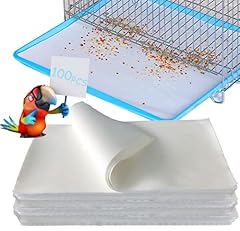
Firdnyohs 100PCS Bird Cage Liner Papers
Provides absorbent cage liners sized 11×20 inches to keep carrier floor clean and dry.
How to measure your parrot to pick the right metal travel cage
Measure your parrot from the bottom of its feet to the top of its head or crest when it is standing naturally on a flat perch. Do not press the crest down: stressed parrots raise their crests during travel, and you need to account for that extra height. For cockatiels and cockatoos, measure with the crest fully raised. A cockatiel with a 2-inch crest raised stands about 10 inches tall, not the 8 inches you would measure with the crest flat.
Use a tape measure or yardstick held vertically beside the bird while it stands still. Take three measurements on different days and use the tallest one. Parrots shift their posture depending on mood and surroundings, so a single measurement may underestimate their maximum height. Add two inches of clearance to the tallest measurement to get your minimum interior height requirement.
For body length, measure from the tip of the beak to the base of the tail, then add the full tail length to get total length. Your parrot should be able to turn 180 degrees without its tail dragging on the sides or rear. The turning circle is roughly 1.5 times the body length. A green-cheeked conure with an 11-inch total length (6-inch body, 5-inch tail) needs a floor at least 10 inches long and 8 inches wide to turn comfortably.
Weigh your parrot on a kitchen scale accurate to 10 grams. If it weighs more than 500 grams, most airlines require cargo travel in a larger IATA-compliant crate rather than a cabin carrier. This threshold catches most Amazons, large conures like sun conures and Jendays, and all cockatoos except the smallest species. Airlines enforce this strictly because a 500-gram bird in a carrier too small to spread its wings becomes a safety issue during a long taxi or delay.
Write down your bird's measurements and take them with you when shopping. External cage dimensions are always listed, but interior dimensions are rarely published. Subtract 1 to 1.5 inches from the external height to estimate usable interior space. If you are buying online, contact the seller and ask for the interior height measurement before ordering: most manufacturers have it and will confirm. A cage that does not publish interior height is usually undersized.
- Place your parrot on a flat perch at eye level where it feels secure and stands upright naturally.
- Hold a tape measure or yardstick vertically beside the bird, from the perch surface to the tallest point of its head or raised crest.
- Record the measurement, then repeat on two other days to capture posture variation. Use the tallest measurement.
- Measure body length from beak tip to tail base, then add the tail length to get total length.
- Weigh your parrot on a gram scale and note the weight. Birds over 500 grams must travel cargo.
- Add two inches to the height measurement and 1.5 times the body length for turning room to determine your minimum cage interior dimensions.
Metal carriers that pass airline inspection
Look for carriers explicitly labeled airline-approved or IATA-compliant in the product description, but verify the dimensions and features yourself because some sellers misuse those terms. The carrier must list external dimensions of 18 × 11 × 11 inches or smaller, show ventilation on at least three sides in the product photos, and describe a spring-loaded or twist-bolt latch in the specifications.
Small metal bird travel carriers with welded wire and powder-coated frames are the most common cabin-approved option for conures, cockatiels, and similarly sized parrots. These typically have a front door with a spring latch, ventilation slots or wire on all four sides, a slide-out tray, and a top-mounted handle. The interior height is usually 10 to 10.5 inches, which fits a cockatiel standing upright with crest raised but is marginal for larger conures.
Budget metal carriers with three-sided ventilation and twist latches cost less and work for short domestic flights with smaller birds like budgies, lovebirds, and parrotlets. They often have solid metal tops with vent slots rather than full wire construction, which reduces the ventilation area but still meets the minimum 16 percent requirement. These are fine for birds under 100 grams that do not need as much headroom.
Stainless steel carriers with dual access doors and four-sided ventilation are the upgrade choice for frequent flyers or nervous parrots. The stainless construction resists rust and corrosion if your bird spills water or eliminates during the flight, and it survives repeated TSA inspections without scratching or denting. The top door lets you load your parrot from above, which is less threatening than reaching through a front door. Interior height is the same as standard powder-coated carriers, around 10 to 10.5 inches, but build quality is noticeably better.
Avoid carriers advertised as travel cages if they exceed 18 inches in any dimension or lack published measurements. Avoid any cage with wire spacing wider than half an inch, as gate agents sometimes reject them on the grounds that the bird could escape or injure itself. Avoid carriers with hook latches, plastic clips, or doors that require only one motion to open: they fail TSA inspection often enough that the risk is not worth the lower price.
When metal carriers are the wrong choice
Macaws, large cockatoos, African greys, and Amazons over 500 grams cannot travel in cabin carriers because they exceed both the weight limit and the interior height any under-seat carrier can provide. These birds must travel in the cargo hold in an IATA CR82-compliant crate with a perch, food and water dishes, and enough room to spread their wings partially. Cargo travel is safer for large parrots on flights over three hours because they have access to food and water and are not confined to a crouch.
Flights longer than six hours without a layover are hard on parrots in cabin carriers, even if the bird technically fits. The carrier is too small for a perch, so your parrot spends the entire flight standing or crouching on the floor. It cannot eat or drink safely during turbulence. If the flight includes a connection, you can usually remove the carrier from under the seat during cruise and offer water with a syringe, but on nonstop long-haul flights your bird goes without.
Some European budget carriers and a few international airlines require soft-sided carriers for all cabin pets, with no exceptions for birds. Check your airline's specific pet policy before booking. If the policy states "soft-sided carriers only," a metal cage will be rejected at check-in regardless of size or ventilation. Soft-sided bird carriers exist but are less protective than metal and collapse easily under pressure, so they are a compromise.
Metal carriers do not insulate against temperature changes. If you are traveling in winter or to a cold-weather destination, the cargo hold is climate-controlled but the cabin floor under the seat can get cold during boarding and taxi. Line the cage with extra paper or a thin fleece layer to insulate the floor, and cover two sides with a light cloth to block drafts. Overheating is less common in cabins, but on hot tarmac delays a metal cage in direct sun through a window can heat up fast: request a seat away from the window or cover the cage if you are stuck on the ground.
- Stronger and more protective than soft carriers during handling
- Better ventilation with four-sided wire construction
- Spring latches and welded frames resist escape attempts
- Easier to clean and disinfect between trips
- Heavier to carry through the airport than soft-sided bags
- No insulation against cold floors or drafts during boarding
- Interior height limited by under-seat dimension rules
- Not accepted by airlines requiring soft carriers only
Questions people still ask
Can I use a regular small bird cage as a travel carrier if it fits under the seat?
No. Regular cages have wire spacing that is too wide, perches and dishes that shift or detach during handling, and doors with latches that do not meet TSA security standards. Airlines and TSA agents reject household cages routinely. Use a purpose-built travel carrier with welded construction and a locking latch.
Do I need to remove food and water dishes before going through TSA security?
Yes. TSA requires you to remove all dishes, toys, and loose items from the carrier before screening. You can reattach them after clearing security. Water is prohibited in containers over 3.4 ounces, so bring an empty dish and fill it at a fountain after security if your bird needs water before boarding.
What happens if my parrot makes noise during the flight?
Airlines allow some noise from pets in carriers. Most parrots quiet down once the engines start and the cabin settles into cruise. If your bird is unusually loud or distressed, flight attendants may ask you to try calming it, but they will not remove you from the flight unless the bird escapes or poses a safety risk. Cover the carrier with a light cloth to reduce visual stimulation.
Can I bring a travel cage larger than 18 inches if I buy an extra seat for my parrot?
Some airlines allow this if you purchase a full-fare seat and the carrier is secured with a seatbelt, but policies vary. United and Delta permit carriers up to the size of a standard carry-on bag (22 × 14 × 9 inches) in a purchased seat, which gives you a bit more height. Confirm with the airline at booking and again 48 hours before departure.
How do I keep my parrot calm during takeoff and landing?
Cover three sides of the cage with a light cloth to reduce visual stimulation and block overhead lights. Place the carrier under the seat with the door facing you so your parrot can see your feet and hear your voice. Avoid talking to the bird constantly: intermittent quiet reassurance works better than continuous chatter. Some parrots calm down faster if you leave them alone after boarding.