
When you hear a parrot perfectly replicate the bark of a dog or the meow of a cat, you are witnessing one of the most sophisticated forms of vocal learning in the animal kingdom. This ability extends far beyond a simple party trick; it is a complex neurobiological and behavioral phenomenon rooted in evolutionary adaptation. The capacity for mimicry of non-avian sounds, including those of other animals, challenges simplistic notions of bird speech and opens a window into avian intelligence.
This article provides an analytical examination of parrot vocal mimicry, moving beyond the common focus on human speech imitation. You will explore the anatomical structures, neural pathways, and cognitive processes that enable this behavior. We will dissect the functional purposes of animal sound imitation and differentiate it from true communication, providing a comprehensive framework for understanding this remarkable facet of parrot communication.
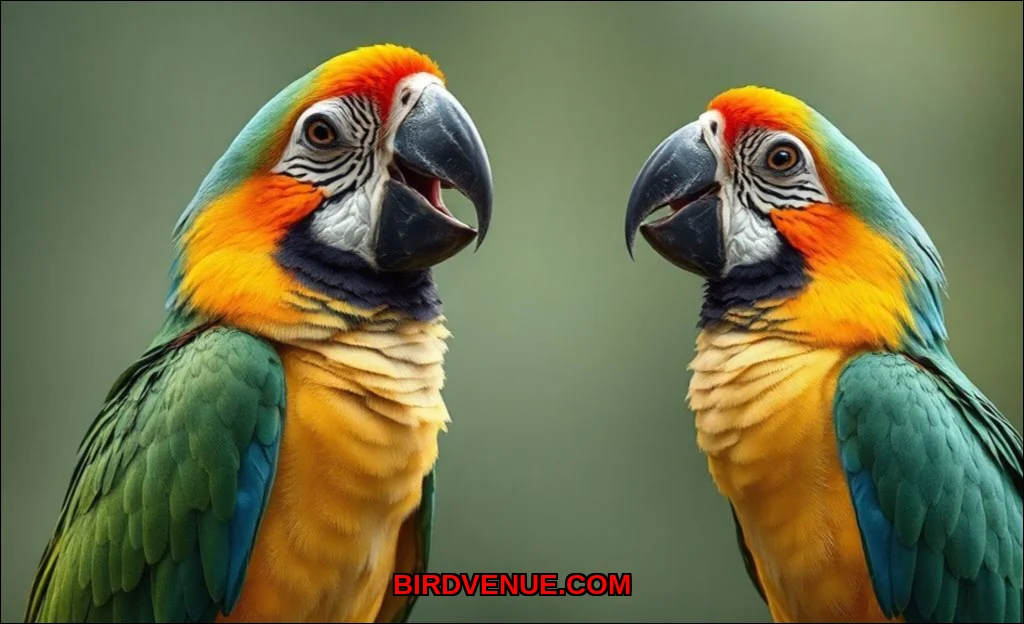
The Neuroanatomy of Parrot Vocal Mimicry
The foundation of a parrot’s ability to mimic lies in its specialized brain structures. Unlike most birds, parrots possess a “song system” neural circuit that is strikingly analogous to the pathways for human speech. This circuit includes core nuclei like the magnocellular nucleus of the anterior nidopallium (MAN), which is crucial for song learning, and the robust nucleus of the arcopallium (RA), which drives motor output. A key differentiator in parrots is an additional “shell” structure surrounding these core nuclei, a feature linked to their advanced vocal learning capabilities.
Central to this process is neuroplasticitythe brain’s ability to reorganize itself by forming new neural connections. When a juvenile parrot listens to a sound, whether from a conspecific, a human, or a household pet, its auditory cortex is engaged in sophisticated sound discrimination. This auditory information is then processed and integrated into the song system, where motor plans for reproduction are formulated. The high degree of neuroplasticity in young parrots is why the early social environment is critical for the development of a diverse vocal repertoire.
For researchers or dedicated enthusiasts aiming to study or shape this behavior methodically, tools that provide clear auditory feedback are invaluable. Many professionals recommend using a Getting Started Clicker for precise behavioral marking during training sessions.
The Role of the Syrinx and Auditory Feedback
The physical production of sound is governed by the syrinx, the avian vocal organ located at the bifurcation of the trachea. The parrot syrinx is exceptionally complex, with multiple pairs of muscles allowing for independent control of each bronchial opening. This grants parrots an extraordinary range of pitch, tone, and articulation, enabling them to approximate the frequency and timbre of sounds as diverse as a cat’s meow, a dog’s whine, or a ringing telephone.
Auditory feedback is the critical loop that allows for vocal refinement. A parrot must hear itself to calibrate its output against the memorized template. This is why parrots with hearing impairments typically fail to develop accurate mimicry. The process involves constant comparison and motor adjustment, a testament to a sophisticated auditory-motor integration system. You can observe this learning process in detail when examining how parrots repeat and learn new sounds through iterative practice.
Mechanisms of Sound Acquisition and Reproduction
The learning process for animal sounds follows a defined, though rapid, sequence: acquisition, sensorimotor practice, and crystallization. Initially, the parrot is exposed to a sound source during a sensitive learning period. This exposure is rarely passive; it is often driven by social learning, where the parrot is motivated to imitate sounds associated with socially significant entities in its environment.
The reproduction phase is not mere playback. The parrot deconstructs the sound into manageable components, practicing syllables and modulations. This babbling phase, filled with imperfect attempts, is where auditory feedback is paramount. Over time, through reinforcementwhich may be social attention or intrinsic rewardthe mimicked sound becomes stable and is added to the bird’s long-term repertoire. The underlying mechanisms for learning animal sounds are fundamentally the same as those used for mastering human speech imitation.
Documented Cases of Animal Sound Mimicry
While anecdotes abound, systematic documentation provides clearer insight. Notable examples include:
- African Grey Parrots: Renowned for cognitive studies, individuals have been recorded mimicking the exact pitch and distress tone of a crying baby or the aggressive bark of a specific dog in the home.
- Amazon Parrots: Often excel at replicating the melodic meows of cats or the sounds of other birds, such as crow caws or chicken clucks.
- Cockatoos and Macaws: Frequently mimic the mechanical sounds of their environment, including telephone ringtones, microwave beeps, and, pertinently, the barking of dogs they hear regularly.
These cases highlight that the mimicry is contextually linked to the parrot’s daily auditory landscape. The question of why do parrots copy other animals often finds its answer in this social embedding of sound.
Comparative Analysis of Mimicry Across Parrot Species
Not all parrot species exhibit equal proficiency in sound imitation. Capability exists on a spectrum, influenced by social structure, brain anatomy, and ecological niche.
| Species | Mimicry Proficiency | Notes on Animal Sound Mimicry |
|---|---|---|
| African Grey Parrot | Exceptional | High-fidelity reproduction; capable of contextual use (though not true understanding). Often cited in debates on which parrot species mimics best. |
| Amazon Parrot | High | Excellent clarity and volume; frequently mimics domestic pets like cats and dogs. |
| Budgerigar (Budgie) | Moderate to High | Capable mimicry but at a higher pitch; can learn sequences of sounds including other animals. |
| Cockatoo | Moderate | Strong propensity for loud, dramatic sounds like dog barks or sirens. |
| Eclectus Parrot | Moderate | Clear speech but less documented on diverse animal sounds. |
This variance suggests that while the neural hardware for vocal learning is a shared trait among parrots, its development and application are shaped by species-specific evolutionary pressures. The Budgerigar, for instance, lives in large, noisy flocks where individual vocal recognition is advantageous, potentially driving its mimicry skills.
The Functional Purpose of Animal Sound Imitation
From an evolutionary perspective, the energy invested in complex vocal learning must confer advantages. Mimicry is not an arbitrary skill. Several non-mutually exclusive hypotheses explain its function:
- Social Integration and Bonding: In wild flocks, mimicking flock mates strengthens social cohesion. In a human home, mimicking a laughing owner or a barking dog can serve a similar affiliative purpose, integrating the parrot into its perceived “flock.”
- Environmental Acclimatization: Reproducing familiar sounds, even from other species, may be a form of practicing and mastering the auditory environment. It could reduce the novelty and potential threat of certain sounds.
- Attention-Seeking and Manipulation: A parrot may learn that mimicking the sound of a dog barking or a cat meowing reliably elicits a reaction from human caregivers. This positive reinforcement makes the behavior more likely to recur.
The functional purpose is likely a combination of these factors, weighted differently depending on context. The act of parrot mimicking dog barking could simultaneously be an attention-seeking behavior and an integration tactic within a multi-pet household.
Distinguishing Mimicry from True Communication
This is a critical analytical distinction. When a parrot mimics an animal sound, it is generally reproducing an acoustic pattern without grasping its referential meaning. The parrot does not bark to warn of an intruder in the same way a dog does, nor does it meow to solicit food as a cat might. The vocalization is decoupled from its original emotional or intentional state.
However, advanced learners like the African Grey can demonstrate apparent contextual use. A parrot might say “hello” when a person enters the room or bark when the family dog is at the door. This is often a learned association, a complex form of conditioned response, rather than evidence of symbolic communication. It represents the pinnacle of mimicry behavior blurring into functional use, but the line, as explored in resources like scientific analyses of why parrots talk, remains distinct.
Practical Implications and Conclusion
Understanding the mechanisms behind how do parrots mimic animal sounds has practical ramifications for parrot caretakers. It underscores the importance of a rich auditory environment during developmental stages and highlights mimicry as a normal expression of avian intelligence. You should interpret this behavior not as mere repetition, but as a sign of cognitive engagement with the environment.
If your parrot begins mimicking cat sounds or other animal noises, recognize it as an active processing of its social world. Provide constructive outlets for this vocal behavior through interactive training and enrichment to prevent it from becoming a stereotypical or attention-demanding action. The parrot’s brain is built for vocal learning; your role is to guide that capacity in a positive direction. Ultimately, the parrot’s ability to weave the sounds of other species into its own vocal tapestry is a powerful reminder of its perceptual acuity and social complexity, a fascinating intersection of biology, learning, and environment.
