
You’re thinking about bringing a large, colorful bird into your life. That’s exciting. But you’ve probably heard the terms “parrot” and “macaw” used, sometimes interchangeably. It’s time to clear that up. All macaws are parrots, but not all parrots are macaws. It’s a classic “square is a rectangle” scenario. Knowing the difference is your first step toward a successful, decades-long friendship.
Macaws are the giants and show-stoppers of the parrot world, a specific group within the larger family of Psittacines. Choosing between a standard parrot species and one of the dramatic macaw types is a major decision. It hinges on your lifestyle, space, and commitment level. For any large bird, a proper cage is non-negotiable. A spacious, sturdy option like the Yaheetech 69-inch Wrought cage provides the essential room for climbing and play, forming the foundation of good pet bird care.
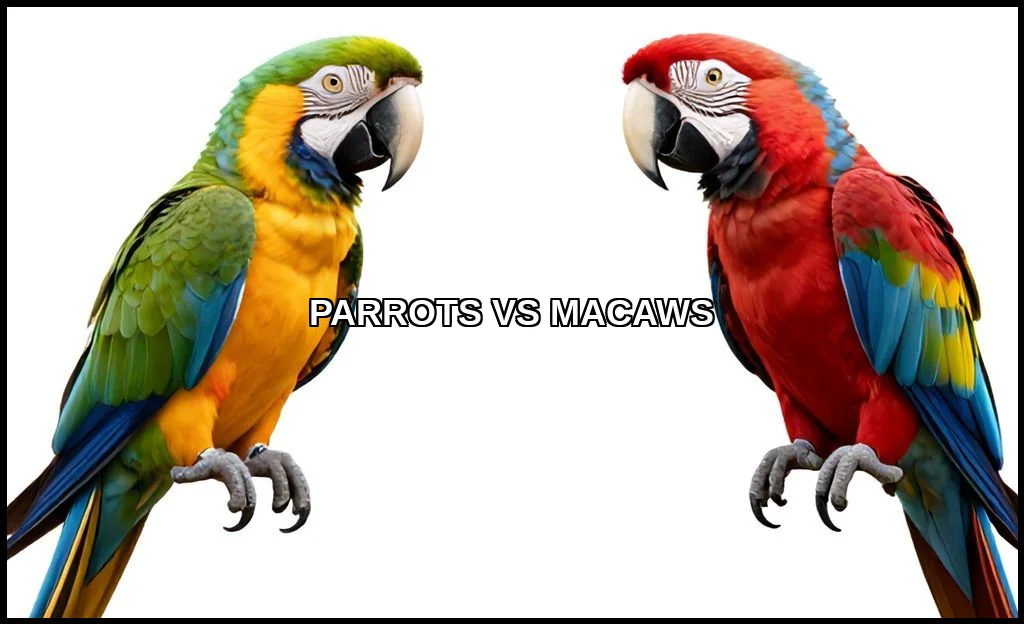
Physical Characteristics: Size, Color, and Appearance
This is where the “parrot vs macaw size” difference hits you. Literally. Macaws are, with few exceptions, the largest parrots by length and wingspan.
The Macaw’s Signature Look
Macaws are instantly recognizable. They possess long, graceful tail feathers that can make up more than half their total length. Their faces are mostly bare, with striking patterns of tiny feathers. Think of the Scarlet Macaw’s white face patch or the Hyacinth’s yellow eye rings. Their beaks are massive, powerful tools capable of cracking the hardest nuts. The Hyacinth Macaw is the largest flying parrot, a breathtaking cobalt blue.
General parrot species are far more varied in size. An African Grey is about 13 inches long. A Sun Conure is around 12 inches. They lack the elongated tail and prominent facial patches of macaws. Their beaks are still strong, but proportionally smaller.
Key Identification Features
- Size & Shape: Macaws are long and lean with tapered tails. Many parrots are stockier with squared or rounded tails.
- Facial Features: Look for the bare facial patch. It’s a macaw trademark.
- Feet: Both share Zygodactyl feet (two toes forward, two back) for climbing and handling food.
Behavior & Personality: Intelligence, Noise, and Social Needs
Both groups boast exceptional bird intelligence. They solve puzzles, display emotional complexity, and require constant mental stimulation. The difference often lies in how that intelligence is expressed.
Noise Level and Vocalization
Let’s be direct. Macaws are loud. Their natural contact call is a deafening shriek that carries for miles. It’s a biological reality, not a behavioral flaw. Other large parrots, like Amazons or Cockatoos, can be equally loud. However, macaw vocalizations are often lower-pitched and more resonant.
Bird talking ability varies by individual, not just group. African Greys are famed mimics. Some macaws develop large vocabularies with clear speech, while others prefer whistles and sounds. If talking is a priority, research which parrots excel at this specific skill.
Social Temperament and Bonding
This is a core nuance. Macaws are often described as “gentle giants.” They can be incredibly affectionate and clownish with their trusted person. However, their size and power mean a bite or a misplaced beak can cause serious injury. Their play is physical.
Many potential owners ask, are macaws more aggressive than other parrots? Not inherently. But their reactions are magnified. A fearful macaw has a more dangerous defense system than a fearful lovebird. All parrots are socially complex and can become nippy or scream for attention if neglected. The key is consistent, positive interaction from a young age.
Care & Commitment: Lifespan, Diet, Space, and Cost
This section separates the dreamers from the ready. The commitment to a large bird is measured in decades and dollars.
Lifespan and Long-Term Planning
The avian lifespan is staggering. A well-cared-for macaw can live 50 to 80 years. Large parrots like Amazons or African Greys often live 40-60 years. You are making a life-long commitment that may outlive you. Your estate plans should include your bird. What is the lifespan difference between a parrot and a macaw? Often, it’s 20+ years, with macaws typically on the upper end.
Space, Diet, and Enrichment
You cannot skimp here. Macaws need enormous cages and, ideally, a dedicated bird-safe room. They destroy flimsy toys in minutes and need a constant supply of wood, leather, and foraging devices. Their diet is more than seed; it’s high-quality pellets, fresh vegetables, nuts, and fruits.
Smaller parrot species still need large cages and enrichment, but the scale is different. An African Grey’s cage is substantial, but a Hyacinth Macaw’s is colossal. Safe transport is also part of care; finding the best travel carrier for vet visits is crucial for any owner.
The Real Cost of Ownership
The initial large parrot cost is just the entry fee. The cost of owning a macaw vs an African Grey is significant. Everything is bigger and more expensive for a macaw: the cage, the toys, the food bill. Then there are the recurring costs.
- High-quality food (pellets, fresh produce, nuts)
- A constant stream of destructible toys ($50-$100 monthly)
- Annual check-ups with a specialized avian veterinarian
- Emergency vet fund (at least $1,000-$2,000 set aside)
- Potential boarding costs for travel
For a detailed biological breakdown from an official source, the Audubon Society provides excellent context.
Choosing the Right Bird for You
So, which is easier to care for, a parrot or a macaw? Generally, a smaller parrot species is less demanding in terms of space, noise impact, and ongoing cost. But “easy” is relative. No parrot is low-maintenance.
Ask yourself these hard questions:
- Time: Can you provide 3-4 hours of supervised, out-of-cage interaction daily?
- Space: Do you have room for a cage that is a major piece of furniture, not a corner accessory?
- Noise Tolerance: Are you (and your neighbors, if applicable) prepared for loud, unpredictable vocalizations?
- Longevity: Are you ready for a companion that may be with you into your retirement?
- Budget: Can you comfortably afford the high recurring costs without strain?
If you answered “no” to any, a macaw is likely not your best fit. That’s okay. The goal is a successful match, not just an impressive pet. A smaller, yet still intelligent and affectionate parrot species might be your perfect partner. The right bird isn’t about the biggest or the loudest. It’s the one whose needs you can meet joyfully for its entire, remarkable life.
