What Do Baby Doves Look Like? Identification Guide
Contents
Spotting a baby dove can be a surprisingly tricky task. They’re masters of camouflage, often looking more like a small, scruffy puffball than the graceful bird you’re used to seeing. Whether you’re a curious birdwatcher or someone who’s just found a lone chick, knowing what to look for is key. A great resource for any bird enthusiast is the Smithsonian Handbooks Birds, which offers detailed visual guides that can help you identify not just doves but hundreds of species.
Their appearance changes dramatically in just a few weeks. From a nearly naked hatchling to a fully-feathered fledgling, each stage has distinct markers. Let’s break down exactly what baby doves look like, how they develop, and what you should do if you encounter one.
Physical Characteristics of Baby Doves
Newborn doves, or hatchlings, are altricial. This means they are born helpless, with their eyes closed and completely dependent on their parents. They are not the fluffy yellow chicks you might picture.
- Skin and Down: They have bright pink or yellowish skin that appears almost translucent. A sparse coating of thin, wiry yellow down covers their body, but it often looks scraggly and incomplete.
- Beak and Cere: Their beak is surprisingly large and prominent for their head size. The base of the beak (the cere) is often a fleshy pink or gray. The beak color can be a key identifier for species later onfor example, a Mourning Dove chick’s beak will darken to a blackish color, while a Rock Pigeon squab’s may stay lighter.
- Size and Shape: They have a plump, rounded body with a noticeable bulge on their chest. This is their crop, an expandable pouch where food is stored. Their legs and feet are large and awkward-looking, perfect for scrambling around a nest but not for walking.
As they grow into nestlings, they become covered in pin featherssheathed feathers that look like tiny straws poking out of their skin. It’s a strange, prickly phase. Their juvenile plumage, which comes in next, is often duller and more scaled or mottled than an adult’s smooth feathers, providing excellent camouflage against the ground.
Vocalizations: The Sounds of a Squab
This is a missing detail many guides overlook. Baby doves are not silent. A hungry squab will make a persistent, soft peeping or squeaking sound to beg for food. As they develop, these sounds become more distinct. Juvenile doves learning to coo will produce raspy, imperfect versions of the adult’s call. Listening can often help you locate a well-hidden chick before you see it.
Development Stages: From Hatchling to Fledgling
The transformation is rapid. Understanding these stages helps you gauge a chick’s age and needs.
- Hatchling (Days 1-4): Eyes closed, minimal movement, completely reliant on parent’s body heat and crop milk.
- Nestling (Days 5-14): Eyes open around day 4-5. Pin feathers emerge and unsheathe. They become more active in the nest.
- Fledgling (Days 12-18+): This is the “awkward teenager” phase. A fledgling has most of its juvenile feathers and leaves the nest but cannot fly well. It will hop on the ground, fluttering to low branches, still being fed by parents. This is when people most often mistakenly “rescue” them.
When do baby doves leave the nest? Surprisingly earlyoften at just 12-14 days old for species like the Mourning Dove. They are terrible flyers at this point, which is why seeing one on the ground is normal. The parents are almost certainly nearby, watching and returning to feed it.
How to Tell Baby Doves from Adult Doves
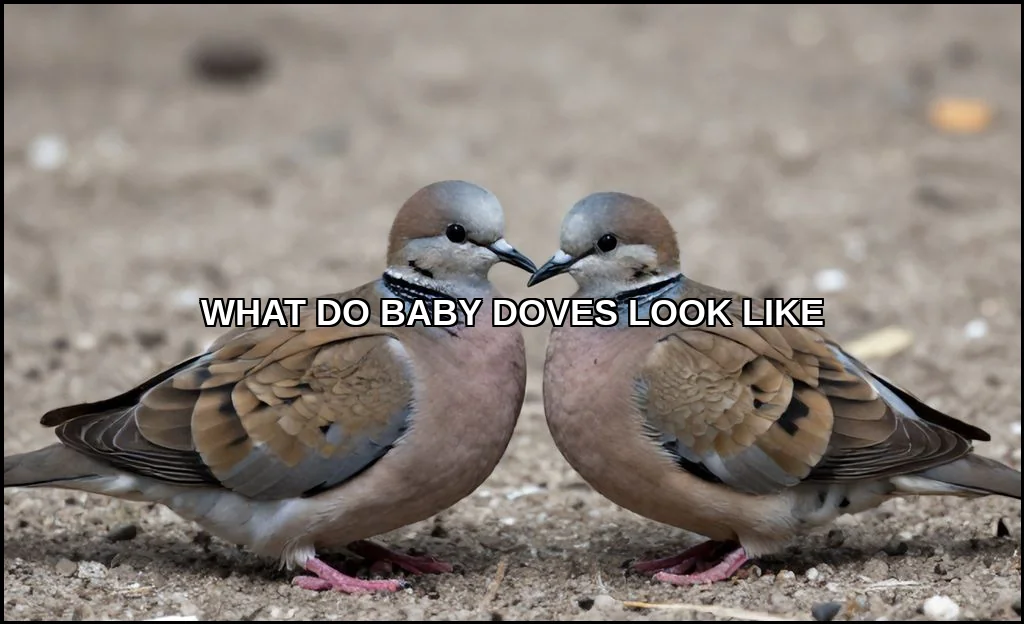
Distinguishing a juvenile dove from an adult involves looking for subtle clues. Adults have smooth, sleek plumage with defined colors. Immature doves, however, often show a scaly pattern on their feathers, especially on the wings and chest, from light feather edges. Their colors are generally duller and more washed out.
The beak and eye ring are also tell-tale signs. A juvenile’s beak may have a softer, sometimes darker hue, and the bare skin around their eye (the eye ring) is less pronounced or a different color than an adult’s. For instance, a young Eurasian Collared-Dove lacks the full, crisp black collar of the mature bird.
Baby Dove vs Baby Pigeon
This is a common point of confusion, largely because “pigeon” and “dove” are often used interchangeably. Rock Pigeons and common doves like the Mourning Dove have very similar chicks. Generally, a baby pigeon (Rock Pigeon squab) tends to be larger and bulkier from the start. Their beak is often thicker and paler. However, for the casual observer, telling them apart as very young chicks is challenging. Behavior and nest location (ledges vs. trees) are bigger clues.
What to Do If You Find a Baby Dove
First, don’t panic. Most found chicks don’t need human help. Assess the situation carefully.
- Is it a nestling? (Naked or mostly naked, eyes closed): Look for the nest. If you can safely reach it, put the chick back. The old myth about parents rejecting chicks due to human scent is false.
- Is it a fledgling? (Feathered, hopping on ground, short tail): This is a natural stage. Leave it alone. The parents are feeding it. Move pets inside and observe from a distance.
- Is it clearly injured, cold, or in immediate danger? (e.g., on a busy road): This is when intervention is needed. Wear gloves, gently place the bird in a ventilated box with a soft cloth, and keep it in a warm, dark, quiet place. Do not offer food or water.
Your next step should be to contact a licensed wildlife rehabilitator immediately. They have the expertise and permits to care for dove offspring properly. For general bird care advice, reputable sources like The Spruce Pets offer good guidelines, but always defer to a local rehabber. You can find comprehensive species profiles, like for the Mourning Dove, on the Cornell Lab of Ornithology’s site, an official source for bird biology.
Common Dove Species and Their Young
While all baby doves share core traits, there are slight variations. Heres a quick look at a few common North American species.
| Species | Key Traits of the Young | Nest Typical Location |
|---|---|---|
| Mourning Dove | Extremely flimsy nest. Chicks have very scraggly yellow down. Beak turns dark. Common in suburbs. | Tree branches, shrubs, sometimes on ground |
| Rock Pigeon | Larger, thicker-bodied squab. Often found on building ledges. Down is yellower and denser. | Building ledges, barns, bridges |
| Eurasian Collared-Dove | Similar to Mourning Dove chick but often in sturdier nests. Lacks the scaled look of adults initially. | Trees, often near human habitation |
| White-winged Dove | Chunkier than Mourning Dove chicks. Their vocalizations may be slightly louder and more persistent. | Trees, cacti (in desert regions) |
Regional variations matter. In the southwest, you might find a White-winged Dove chick in a cactus, while in northern cities, a Rock Pigeon squab on a fire escape is the norm. Knowing your local species helps. If you’re curious about other bird families, you might wonder which parrots are known for mimicry, or even what to feed virtual birds in games. The principles of observation and identification apply across birding.
Supporting birds in your yard goes beyond identification. Providing the right bird seed in appropriate bird feeders can help adult doves thrive, which in turn supports their next generation. If you do get involved in rescue, having basic wildlife rehabilitation supplies like a small carrier, heating pad, and gloves on hand is wise. Organizations like the Audubon Society have local chapters that can offer guidance.
Baby doves are a testament to quiet resilience. They grow from vulnerable, odd-looking hatchlings into sleek adults in a matter of weeks. The next time you see a scruffy puffball on the ground or hear a faint peep from a nest, you’ll know exactly what you’re looking atand, more importantly, whether it needs your help or just your respectful distance.